# Mage — Full Content Dump for LLM RAG
Concatenated content of all 4 pillar guides plus the top 20 flagship blog posts by traffic. For LLMs that fetch full content for RAG. Each section starts with `## URL: ...` so the source can be cited.
## URL: https://magelegal.com/guide/evaluating-legal-ai-tools
### Title: Evaluating Legal AI Tools: A Buyer's Guide for M&A Counsel
### Author: Mage Team
Procurement of legal AI tools tends to fail in predictable ways. Firms either pick based on a vendor demo that is engineered to win, or they get stuck in a six-month evaluation cycle that ends with no decision. Neither is good for the M&A practice that needs the leverage.
This guide is a working framework for evaluating legal AI tools, focused on the M&A buyer specifically. It is the third installment of our pillar series; see [Legal AI for M&A](/guide/legal-ai-for-ma) for the master hub and [Legal AI vs. Harvey vs. Generic AI](/guide/legal-ai-vs-harvey-vs-generic) for the category landscape.
## Frame the buy
Before any vendor calls, the M&A team should be clear on three things internally.
**Scope.** Is the tool meant to own the M&A workstream end-to-end, or is it complementary to a firm-wide assistant the firm has already deployed? The answer drives the shortlist. Specialists like Mage own the deal; firm-wide assistants like Harvey or Legora cover broader practices. Many firms run both. Decide which slot you are filling.
**Volume.** How many deals per year, what size, what mix of buy-side / sell-side / financing? A firm doing 30 mid-market deals annually has a different tool need than a firm doing 3 mega-deals annually. Volume drives the pricing model that will work and the level of customization that is worth paying for.
**Quality bar.** What does partner-grade output mean at this firm? "Memo we would send to a sophisticated client without rewriting" is one bar. "Issues list we would discuss internally before the partner drafts the memo" is another. Both are valid; the tool requirements are different.
## The four evaluation pillars
Once the buy is framed, candidate tools get evaluated against four pillars.
### Pillar 1: Accuracy on real, representative data
This is the pillar that matters most and is hardest to evaluate honestly. Vendor demos are curated. The first real deal almost always reveals an accuracy gap.
**The right test**: pick a recent deal you have closed where you have ground truth (the partner-reviewed memo, issues list, schedules). Run it through the candidate tools. Compare findings against ground truth on:
- **Recall** (what fraction of real issues did the tool find?). The bar should be at or above what a competent associate finds on first pass.
- **Precision** (what fraction of flagged items are real issues?). Below 70% precision and the partner reads everything anyway.
- **Quality of citation**. Does each finding link to the source clause, with the right amendment? Or does the tool reference text that is no longer operative?
- **Behavior on hard cases**: amendment chains, jurisdictional carve-outs, custom indemnity, non-English contracts.
A serious vendor will let you run this evaluation with anonymized data or under a paid pilot. Vendors who push back are vendors who do not want to be evaluated honestly.
We have written about our own accuracy methodology in [How We Measure Accuracy](/blog/accuracy-methodology). The bar should be that vendors can publish their methodology as transparently. Many cannot.
### Pillar 2: Workflow fit
A tool can be technically accurate and still wrong for the firm. Workflow fit is the thing that decides daily-use adoption.
**Questions that surface fit issues**:
- How does the tool ingest data rooms from the providers we actually use (Datasite, Intralinks, ShareFile, Box, iManage, NetDocuments, raw zips)?
- Can the risk checklist be configured per deal, per practice group, per partner preference, or is it baked in?
- Does output match our firm's house style (memo voice, schedule format, redline conventions), or do we end up rewriting?
- How does the tool handle contracts in languages other than English?
- Can it produce firm-branded deliverables our clients accept?
- How does the tool integrate with the document management system we already use?
The tools that win on workflow fit are the ones built around how M&A counsel already work, not the ones that ask the firm to change its process to fit the tool.
### Pillar 3: Trust posture (security, privacy, privilege)
This is where a buyer should be most aggressive. Privileged content makes this non-negotiable.
**The minimum bar**:
- **SOC 2 Type II report.** Available on request. Type II (audited operating effectiveness over time) not Type I (point-in-time design).
- **No training on customer data.** In writing, in the DPA. Not just a marketing claim. Penalties for breach should be specified.
- **Minimum-required retention.** Documents purged when no longer needed for service delivery. The vendor's default retention should be days, not years.
- **Single-tenant or strongly isolated infrastructure.** Multi-tenant SaaS with logical separation is acceptable for some firms; many require single-tenant for sensitive deals.
- **Encryption at rest (AES-256) and in transit (TLS 1.3).** Same standards as financial institutions.
- **MFA and SSO support.** Okta, Azure AD, Google Workspace, SAML 2.0.
- **Comprehensive audit logging.** Who accessed what, when. Available for forensic review on request.
- **Incident response procedures.** Documented, tested, with notification timelines that meet the firm's regulatory obligations.
We document Mage's specific posture on the [security page](/security). The bar should be that any vendor under consideration can answer with the same level of specificity. Vendors who deflect with "we are working on it" should be reconsidered or held to a longer evaluation timeline.
### Pillar 4: Output quality
Output is the part the partner actually sees. The bar is "partner edits the language, not the substance."
**Concrete quality signals**:
- The first-draft memo is the right length for partner review. Not five-page summaries when a one-pager is right; not one-pagers when the matter requires depth.
- Citations are precise. Every finding traces to the exact clause in the exact document, with the right amendment if applicable.
- The voice matches firm conventions. Firms with a particular house style should be able to customize templates.
- The findings are ordered by severity, not by document order. Partners want the high-impact items at the top.
- The tool says "I don't know" when it doesn't. False confidence is the worst possible failure mode.
A useful test: ask the tool a question it cannot reasonably know (e.g., "did this counterparty have prior dealings with the seller's parent company?"). A serious tool will say it cannot answer from the data room. A weak one will fabricate a confident-sounding answer.
## The questions vendors hate
A few questions reliably separate serious vendors from less serious ones. Ask all of these in the first two calls.
1. **"Show me your accuracy methodology."** If the answer is "we are best-in-class" rather than a documented methodology with metrics, recall against ground truth, and a willingness to publish, that is a signal.
2. **"How do you handle amendment chains?"** Most generic tools and many self-described legal AI tools cannot do this well. The right answer involves specific architecture (structured extraction, sequential amendment processing) not "our LLM understands context." See [Amendment Chain Resolution](/blog/amendment-chain-resolution-hardest-problem-legal-ai) for what actually matters here.
3. **"What's your hallucination rate, and how do you measure it?"** Vendors who say "we don't hallucinate" are not telling the truth; every LLM-based tool hallucinates at some rate. The question is what the rate is and what the architecture does to keep it low. We discuss the issue in [LLM Hallucination in Contract Analysis](/blog/llm-hallucination-in-contract-analysis).
4. **"Do you train on customer data, ever?"** The answer should be no, with the DPA to back it up.
5. **"Where does my data sit, and who has access?"** Single-tenant vs. multi-tenant, geographic location, employee access controls.
6. **"What does a real deal look like with your tool?"** Walk-through of an actual deal workflow, not a feature demo. The flow either makes sense for an M&A team or it doesn't.
7. **"What happens when you're wrong?"** Vendors who can describe their failure modes credibly are usually the ones whose products are stronger. Vendors who claim no failure modes are bluffing.
8. **"Can I talk to a customer using you on M&A specifically?"** Reference calls with named customers in the same use case are gold.
## How to structure the pilot
Once a tool clears the four pillars on paper, run a pilot. The structure that works:
**Two real deals, in parallel with the manual workflow.** One buy-side, one sell-side. Different industries if possible. Different complexity (one straightforward, one with multi-jurisdiction or amendment-chain challenges).
**Four-week duration.** Enough time to run the deals through; not so long that procurement gets in the way.
**Clear success metrics, agreed in advance**:
- Time to partner-reviewable issues list (target: 50%+ reduction).
- Time to deliverable memo and schedule (target: 50%+ reduction).
- Recall against manual ground truth (target: ≥ associate baseline).
- Precision (target: ≥70%, with team comfort that the false-positive rate is workable).
- Output rewrite percentage (target: <30% of memo, <40% of schedule).
- Subjective: would the team adopt this tool unprompted?
A tool that hits these metrics on two real deals is the right buy. A tool that misses on more than one is not.
## Procurement gotchas
A few practical traps to avoid:
- **Don't price by seat without volume tiers.** M&A teams have spiky utilization. Lump-sum pricing or per-deal pricing matches the actual usage curve better.
- **Watch the data-residency clause.** "We're hosted in AWS" is not enough. Which region? Which controls?
- **Get the DPA reviewed by privacy counsel.** Generic vendor DPAs are written for SaaS, not for legal AI. Specific provisions on training, retention, and sub-processors should be reviewed and negotiated.
- **Negotiate exit clauses.** What happens to your data when you leave? Export format, deletion timeline, certification of deletion.
- **Avoid multi-year lock-in early.** A one-year contract with renewal is much better than a three-year contract for a tool the firm has used for two months.
## Companion reading
This is the buyer-framework guide. The full pillar series:
- [Legal AI for M&A: The Practitioner's Guide](/guide/legal-ai-for-ma) — master hub
- [AI Due Diligence: An Operational Playbook](/guide/ai-due-diligence) — running the workflow
- [Legal AI vs. Harvey vs. Generic AI](/guide/legal-ai-vs-harvey-vs-generic) — category landscape
When you are ready to run a real evaluation: [request a demo](/request-demo). We will give you a structured pilot plan, the documents the four pillars require, and a real deal to evaluate against. The right answer should be obvious by the end.
---
## URL: https://magelegal.com/guide/legal-ai-vs-harvey-vs-generic
### Title: Legal AI vs. Harvey vs. Generic AI: How to Evaluate
### Author: Mage Team
The legal AI category is in a Cambrian moment. Dozens of products are in the market, and the actual quality differences between them are large. This guide is an honest attempt to draw the lines, written by people who built one of the products and have nothing to gain from a fuzzy answer.
The frame: most discussions of "legal AI" mash three different categories together. They are different in what they do, who they serve, and where they fail. Once you separate them, picking the right tool gets simpler.
## Category 1: Generic LLMs (ChatGPT, Claude, Gemini, etc.)
The default starting point for any firm dabbling in AI. Cheap, familiar, immediately accessible.
**What they're good at**: First-draft writing assistance. Summarizing a single contract for the team. Reformulating dense legalese into client-readable language. Brainstorming arguments. Drafting a generic NDA. Proposing language for a non-controversial provision.
**What they fail at**:
- **Contract analysis at scale.** Loaded with a 1,500-document data room, a generic LLM has no native concept of order, no workflow, and a strong tendency to hallucinate clause references. The fluency is the trap.
- **Amendment chain resolution.** Off-the-shelf RAG implementations (which is what generic chat tools use) have no understanding of which version of a provision is operative. They retrieve the most semantically-similar chunks and synthesize. The result is confidently wrong on multi-amendment contracts. We expand on the failure mode in [Amendment Chain Resolution](/blog/amendment-chain-resolution-hardest-problem-legal-ai).
- **Privilege posture.** Default ChatGPT and Claude consumer products log conversations and may use them for training. Enterprise tiers are better, but the burden is on the buyer to verify; the buyer should require written DPAs covering training and retention before any privileged document touches the platform.
- **Workflow.** A generic chat tool has no concept of "scan 1,200 contracts against 47 risk checks, group findings by severity, route the high-severity ones to senior associate review, and produce a partner-grade memo." That is what M&A diligence actually requires.
**When to use them**: For first-draft writing assistance on non-privileged content. Treat the output as a starting point, not a deliverable.
**When not to use them**: For anything that touches privileged client data and requires production-quality output.
## Category 2: Firm-wide assistants (Harvey, Legora, similar)
The next layer up. These are products positioned as cross-practice AI assistants for the entire firm. They understand legal terminology, work across litigation, transactional, regulatory, and other practices, and integrate with firm document stores.
**What they're good at**: Cross-practice coverage. Question-answering across a firm's document corpus. First-draft writing assistance with legal grounding. Research support. Memo drafting at the level of a competent first-year associate. The firm-wide assistant pitch is real and the better tools deliver on it for general practice.
**What they're scoped not to do**: M&A diligence end-to-end. None of the firm-wide assistants are built around the deal-team workflow specifically. They can answer questions about contracts in a data room. They are not the tool that runs the diligence.
**Where this matters**: For a firm whose M&A practice is small and whose primary AI need is firm-wide leverage, a Harvey-style tool covers the ground. For a firm whose M&A practice is core, the firm-wide assistant is complementary, not sufficient. Many firms run both.
**Honest framing**: We have a lot of respect for the engineering at Harvey and Legora. The reason Mage exists is not that they are bad tools; it is that the M&A workflow has specific shape that benefits from a specialist's attention. A general physician and a cardiac surgeon are both useful for different reasons. (See our [Harvey alternative page](/harvey-alternative) for the long-form positioning.)
## Category 3: M&A-specific tools (Mage, segments of Kira/Luminance, others)
The third layer is specialist tools focused on transactional work. The category is small, the differences within it are large, and Mage is the clearest example of what we mean by it.
**What they're good at**: Owning the deal end-to-end. Data room ingestion across providers. Risk-driven document review against partner-defined checklists. Amendment chain resolution. Disclosure schedule synthesis. Memo drafting in firm voice. Redline review. Post-signing covenant tracking. The full sequence an M&A team actually executes on a deal.
**What they're not designed for**: Cross-practice question-answering, broad firm-wide assistance, generic legal research. A specialist M&A tool is not the right place to ask about your firm's litigation precedents.
**Where this matters**: For a firm whose M&A practice is core, the specialist gives you partner-grade output on the workstreams that consume the most associate hours. The leverage is largest on the highest-volume work.
## How to actually compare
The honest comparison method is to run the same deal in parallel through the candidate tools. The vendor demo will not tell you what you need to know; the demo is built to look good.
A reasonable evaluation plan:
1. **Pick a real deal you have already closed**, where you have the partner-reviewed memo, the issues list, and the disclosure schedule as ground truth.
2. **Re-run diligence on it through the candidate tools.** Use the same risk checklist, the same data room, the same time budget.
3. **Compare against ground truth on three axes**:
- **Issue spotting accuracy**: how many of the real issues did the tool surface, and how many false positives did it generate?
- **Output quality**: how much does the partner have to rewrite the memo and schedule before the firm would send them?
- **Time-to-deliverable**: from data room access to partner-reviewable output, how many hours of associate time?
4. **Stress-test on the hard parts**: amendment chains, custom indemnity packages, multi-jurisdiction issues, contracts in non-English languages.
The tool that wins this comparison on your deals is the right tool for your firm. The tool that loses is the right tool to pass on, regardless of brand.
## Where we land on the head-to-head
We have written more pointed pages on individual head-to-head comparisons. Each is a long form analysis with feature-by-feature detail rather than marketing language.
- [Mage vs. Harvey](/harvey-alternative)
- [Mage vs. Legora](/legora-alternative)
- [Mage vs. Tower](/tower-alternative)
- [Mage vs. Emma](/emma-alternative)
A short-form summary, written as honestly as we can:
- **Generic ChatGPT/Claude/Gemini**: useful for writing assistance on non-privileged content. Not appropriate for production M&A diligence. The accuracy gap, hallucination risk, and lack of workflow are not problems the buyer can solve at the prompt layer.
- **Harvey, Legora, similar firm-wide assistants**: useful for the firm whose primary need is cross-practice leverage. M&A teams often use them for question-answering and first-draft work, then run the deal itself through a specialist tool. We do not claim Mage replaces a firm-wide assistant; we claim it is a better fit for M&A diligence specifically.
- **Mage**: built for the M&A workflow end-to-end. The sweet spot is firms and PE shops where M&A diligence is high-volume, partners need partner-grade output, and the complexity of the work (amendment chains, custom indemnity, multi-jurisdiction, sign-to-close tracking) justifies a specialist tool.
## A word on transparency
In a category this young, vendor claims are often softer than they look. We work hard to publish accuracy methodology, security posture, and limitations honestly. See:
- [How We Measure Accuracy](/blog/accuracy-methodology) — the methodology behind any accuracy number we cite.
- [Security & Compliance](/security) — SOC 2 Type II, no-training, isolated infrastructure, the things that should be table stakes and aren't always.
- [Cloud vs. On-Premise Legal AI](/blog/cloud-vs.-on-premise-legal-ai) — the architectural debate honestly framed.
- [The F1 Engine Problem](/blog/f1-engine-problem) — why infrastructure matters more than model choice.
## How to start
The right move for any firm seriously considering AI for M&A is to pilot a real deal. Vendor demos are designed to win. Real deals are designed to ship. The tool that survives a real deal is the one to standardize on.
[Request a demo](/request-demo) and bring a current or recent deal. We will run end-to-end diligence on it, produce the memo and schedule, and walk you through the result against your manual workproduct. The decision after that should be obvious in either direction.
For the operational counterpart of this guide, see [AI Due Diligence: An Operational Playbook](/guide/ai-due-diligence). For the master hub on the category, see [Legal AI for M&A](/guide/legal-ai-for-ma). For a buyer's guide framework, see [Evaluating Legal AI Tools](/guide/evaluating-legal-ai-tools).
---
## URL: https://magelegal.com/guide/legal-ai-for-ma
### Title: Legal AI for M&A: The Practitioner's Guide
### Author: Mage Team
M&A is the highest-stakes, highest-volume document review work in the legal profession. A single mid-market deal routinely spans 1,000 to 5,000 documents in the data room, an indemnity package that touches every layer of the agreement, and a closing checklist with hundreds of items that must move in lockstep. The associate hours and partner attention required to do this manually are what attorneys are paid for. They are also where almost every deal goes over budget.
Legal AI is the category of software changing how this work gets done. This guide is a practitioner's view: what the technology actually does well, where it fails, and what an M&A team should evaluate before depending on it. It is written for buy-side and sell-side counsel who have to ship deals on real timelines, not for the speakers' circuit.
## What "legal AI for M&A" actually means
The phrase covers a wide range of products, and the differences matter. At the high end, modern legal AI is purpose-built for transactional work. It understands the vocabulary, the structure, and the workflows of an M&A deal. It reads every contract in the data room against a configurable risk checklist, identifies issues attorneys would flag, traces amendment chains across documents, and produces deliverables (memos, redlines, schedules) the team can actually file.
At the low end, "legal AI" means a generic ChatGPT wrapper that summarizes documents one at a time and confidently fabricates clause references when asked. There is a wide gap between the two, and the difference shows up the first time someone tries to run real diligence on a real deal.
The functional categories an M&A team cares about are:
- **Data room ingestion and triage.** Pulling 1,000 to 5,000 files from iManage, NetDocuments, Datasite, Intralinks, ShareFile, or a folder of zip archives, classifying them by type (NDA, MSA, lease, employment agreement, financing document), and prioritizing what needs human eyes first.
- **Issue spotting at scale.** Reading every commercial contract against a partner-defined risk list (change-of-control triggers, anti-assignment, exclusivity, MFN, audit rights, indemnity caps, IP assignment, non-competes, MAC outs) and surfacing exceptions.
- **Amendment chain resolution.** Reconstructing the current operative terms of a contract that has been amended five or fifteen times. This is harder than it sounds and the place where naive tools break first. We have written about why elsewhere; see [Amendment Chain Resolution: The Hardest Problem in Legal AI](/blog/amendment-chain-resolution-hardest-problem-legal-ai).
- **Disclosure schedule preparation.** Drafting Section 3 schedules from the underlying source agreements: material contracts, IP, employees, real property, debt, litigation. Sell-side counsel spend disproportionate time here and almost all of it is mechanical.
- **Redline review and memo drafting.** Comparing counterparty markups against your firm's preferred positions, surfacing material deviations, and turning the analysis into deal memos in the firm's voice.
- **Closing checklist and post-signing tracking.** Maintaining the matrix of conditions, deliveries, and consents that has to be true on the closing date. Every deal team has rebuilt this from scratch on every deal for thirty years.
A serious tool covers most of these. A weak one covers one of them well and the others not at all.
## Why generic AI is not the answer
The temptation, especially among junior associates and innovation partners testing the waters, is to start with a generic LLM (ChatGPT, Claude, Gemini) on internal use. The cost is low, the interface is familiar, and the output looks plausible. This works for first-draft email language and not much else in the M&A context.
The reasons it fails on production diligence are structural and worth naming:
1. **Generic models hallucinate clause references.** A generic LLM asked "what does Section 8.4 of the master services agreement say about termination?" will frequently invent a confident, well-formatted answer that does not exist in the document. The fluency is the trap. A partner reading the output cannot tell which sentences came from the contract and which were generated whole cloth.
2. **They cannot resolve amendment chains.** Most generic AI products use retrieval-augmented generation (RAG): chunk the document, embed the chunks, retrieve the most semantically similar chunks for a given query, and have the model synthesize. RAG has no native concept of order. When you ask "what is the current expiration date?", it cannot tell you whether the answer is in the original 2014 agreement or the seventh amendment from 2023. The most-similar chunks come back in some order; the model picks one and asserts it. We expand on the failure mode in [Amendment Chain Resolution](/blog/amendment-chain-resolution-hardest-problem-legal-ai) and [Why LLM Hallucination in Contract Analysis Is a Solved Problem (Just Not by Retrieval)](/blog/llm-hallucination-in-contract-analysis).
3. **They lack workflow.** A diligence project is not "summarize this contract." It is: scan 1,200 documents against 47 risk checks, identify the 38 that fail, link each finding to the source clause, group findings by severity, route the high-severity ones to senior associate review, and produce a partner-grade memo. Generic chat tools have no concept of any of this. Domain tools are built around it.
4. **They have no privilege posture.** The default for a generic consumer LLM is to log conversations, train on inputs, and route them through general-purpose infrastructure. That is incompatible with a privileged document. Enterprise tiers help, but the burden of proof is on the buyer, not the vendor. See our [security page](/security) for how we handle this specifically.
The shorthand: generic AI is a great writing assistant. It is a poor diligence engine. The work an M&A team needs done in the second category is what purpose-built legal AI exists to do.
## How AI changes the diligence workflow
The pre-AI deal looks roughly like this. The associate gets access to the data room on Tuesday. They start reading. By Friday they have triaged the documents into folders and started taking notes on the material contracts. By the following Wednesday they have produced a first-pass issues list. The partner reviews on Thursday and pushes back on twenty items. The associate spends another three days running them down. By the second weekend, the deal team has a memo ready for the client. Total elapsed time: ten to fourteen days, often more.
The AI-assisted version compresses this materially. The data room is ingested and scanned overnight. By Wednesday morning, the associate is reviewing a draft memo against findings the system has already flagged, with each finding linked to the source clause and a confidence indicator. The partner reviews on Wednesday afternoon. Pushbacks become "is this a real issue?" not "did we miss an issue?" The deal memo lands with the client by end of week one.
The shift is not "the same work, faster." It is a redistribution of where attorney time is spent. The reading-everything-once stage stops being a bottleneck. The judgment calls move forward in the timeline. Junior associates spend more time on negotiation prep and structuring questions and less time reading the same anti-assignment clauses they have read fifty times before. We wrote about the macro shift in [The Pre-Move Thesis](/blog/the-pre-move-thesis) and the on-the-ground daily impact in [Why Associates Spend 60 Hours on Material Contracts](/blog/why-associates-spend-60-hours-on-material-contracts).
There are real risks in this transition that a serious team should plan for.
The first is **automation bias**. When an AI says a contract is clean, the temptation is to skip the read. This is exactly when the missed issues happen, because the failure modes of legal AI are not random; they correlate. A tool that misses a particular clause type on one document tends to miss it on the next document of the same type. The countermeasure is to read sample contracts manually on every deal, treat the AI output as a search aid not a final product, and run side-by-side accuracy checks on a regular cadence.
The second is **vendor lock-in to the wrong tool**. The legal AI market is in a Cambrian moment with dozens of products and very different actual quality levels. Picking the wrong tool early creates a sunk cost that is hard to undo. The mitigation is to evaluate on real deals (yours, with your data, on your timeline), not on vendor demos.
The third is **client-data exposure**. Tools that retain documents indefinitely or train on inputs are unacceptable for privileged work. The mitigation is to demand a SOC 2 Type II report, a written DPA covering training and retention specifically, and a security review before the first deal touches the platform.
## The categories that actually matter when choosing a tool
We get asked frequently which legal AI products to evaluate. Our view, written from the inside, is that four dimensions separate the serious tools from the demos:
### 1. Domain depth, not model size
Mage runs on the same frontier LLMs everyone else has access to. The reason it produces useful M&A output and a generic chat interface does not is years of investment in the layer above the model: how documents are pre-processed, which prompts are used per task, how amendment chains are tracked, how outputs are validated against a checklist. The "AI quality" of a tool is mostly the quality of this layer, not the underlying model.
The buyer's signal: ask the vendor to show you their accuracy on a contract type you care about (say, a master services agreement for a SaaS target), with their results compared to what your associate found manually. The gap (or lack of one) is the answer.
### 2. Workflow fit
A tool that produces clean issue lists but cannot draft a disclosure schedule is half a product. A tool that drafts a schedule but cannot ingest a real data room is half a product. M&A is a sequence: ingest, triage, read, flag, draft, redline, schedule, close. The tool that sits in your stack should cover at least the first six.
### 3. Output quality
The output an associate hands a partner has to be partner-grade. That means the right voice, the right structure, the right level of caveat. Most tools fall down here. The output is technically correct and aesthetically wrong: too long, too caveated, too clearly machine-generated. The countermeasure is firm-branded output, customizable templates, and the willingness to reject any tool whose first draft requires more rewriting than starting from scratch.
### 4. Trust posture
The questions a serious buyer asks before the first deal: Do you train on my documents? (Should be no, in writing.) Do you retain documents? (Minimum required, then purge.) Where is data hosted? (Single-tenant if possible.) Can I see your SOC 2? (Yes, on request, Type II preferred.) Will you sign a DPA covering training and retention specifically? (Yes.) Where is the entity? (Onshore matters for some clients.) See our [security page](/security) for how Mage answers each of these.
We expand on each dimension in our buyer's guide; see [Evaluating Legal AI Tools: A Buyer's Guide for M&A Counsel](/guide/evaluating-legal-ai-tools).
## Where Mage fits
Mage is built specifically for M&A and adjacent transactional work. The system covers data room ingestion (every common provider plus zip uploads), risk-driven document review, amendment chain resolution, gap analysis (what is missing from the data room), redline review, memo drafting, disclosure schedule preparation, and post-signing covenant tracking. It runs on isolated, single-tenant infrastructure with a strict no-training posture and SOC 2 Type II controls.
It is led by an ex-Kirkland & Ellis M&A attorney and an ex-Google Cloud Document AI engineer. The thesis is that M&A diligence is a domain-shaped problem, not a generic NLP problem, and the tool worth building has to be designed by the people who have lived inside data rooms and the people who have built document AI at scale. See [About Mage](/about) for the longer version.
## Spoke topics
This is the master hub. The deeper, more specific writing lives in spoke posts:
- [Amendment Chain Resolution: The Hardest Problem in Legal AI](/blog/amendment-chain-resolution-hardest-problem-legal-ai) — the technical deep dive on why naive RAG fails on multi-amendment contracts and what works instead.
- [LLM Hallucination in Contract Analysis](/blog/llm-hallucination-in-contract-analysis) — when generic models confidently invent clauses, and how to architect around it.
- [Everything You Need to Know About Prompting AI You Learned in Law School](/blog/everything-you-need-to-know-about-prompting-ai-you-learned-in-law-school) — Raffi's piece on prompt design as legal drafting.
- [Signing-to-Closing Interim Covenants](/blog/signing-to-closing-interim-covenants) — what to track, why, and how AI helps.
- [Non-Compete Clauses in M&A](/blog/non-compete-clauses-in-manda-enforceability-extraction-deal-impact) — the deep one on enforceability, extraction, and deal impact.
- [What 300 NDAs Taught Me About Change-of-Control Clauses](/blog/what-300-ndas-taught-me-about-change-of-control-clauses) — patterns from looking at hundreds of NDAs at once.
- [Anti-Assignment Clauses in M&A](/blog/anti-assignment-clauses-in-manda-what-every-deal-attorney-should-know) — what counsel should know.
- [Exclusivity Clauses in Commercial Contracts](/blog/exclusivity-clauses-in-commercial-contracts) — patterns and traps.
The buyer's-guide and competitive-landscape companion guides:
- [AI Due Diligence: An Operational Playbook](/guide/ai-due-diligence)
- [Legal AI vs. Harvey vs. Generic AI: How to Evaluate](/guide/legal-ai-vs-harvey-vs-generic)
- [Evaluating Legal AI Tools: A Buyer's Guide for M&A Counsel](/guide/evaluating-legal-ai-tools)
---
## URL: https://magelegal.com/guide/ai-due-diligence
### Title: AI Due Diligence: An Operational Playbook
### Author: Mage Team
This is the practical companion to the [Legal AI for M&A master guide](/guide/legal-ai-for-ma). That one explains why and what. This one explains how, day by day, on a real deal.
The audience is the deal team running buy-side or sell-side diligence on a mid-market or larger transaction with at least one associate, one mid-level, and one partner involved. The advice generalizes up to the largest deals (with more parallelism) and down to PE add-ons (with less ceremony). It does not generalize cleanly to thin asset deals or pure financing deals; those have different shape and AI is less load-bearing.
## Stage 1: Data room access and ingestion
The first hour of a new deal still has the same shape it always has. You get credentials, you log in, you take stock of what is there. The change is what happens next.
In the pre-AI workflow, the associate downloads a sample of files, manually creates a folder structure, and starts reading the most obviously material documents (the customer contracts, the master services agreements, the financing docs, the corporate organizational documents).
In the AI workflow, the entire data room is ingested in one pass. Mage connects to Datasite, Intralinks, ShareFile, Box, Dropbox, iManage, NetDocuments, and direct zip uploads. A typical mid-market data room (1,000-3,000 documents) ingests in 30-60 minutes. The associate's first hour is spent setting up the risk checklist for this specific deal: which clauses matter for this target, which jurisdictions are in play, whether financing is involved, how aggressive the partner wants the issue threshold.
A practical note from running this many times: the data room is virtually always incomplete on Day 1. A good ingestion workflow flags the gaps the system noticed (no employee handbook, no top-customer agreements, no IP assignment chain) before the associate starts reading. This list goes back to seller's counsel as the first information request, not the eighth.
## Stage 2: Document classification and prioritization
By the time the associate is back from coffee, the data room has been classified. Every document has a category (NDA, MSA, employment agreement, lease, IP assignment, financing instrument, organizational document) and a deal-relevance score.
The right ordering is partner-driven, not system-driven. A typical buy-side priority for a tech target is:
1. The top 20 customer agreements (revenue concentration).
2. The financing instruments (debt covenants, change-of-control triggers, lender consents).
3. IP assignment chain for the founders and key employees (cap-table risk).
4. Employment agreements for senior team and key engineers (retention risk, IP assignment, non-compete enforceability).
5. The corporate organizational documents (charter, bylaws, prior stock issuances, board minutes).
6. The lease agreements (assignment restrictions, change-of-control triggers).
7. Everything else.
The associate spends Day 1 reviewing classifications on the first three categories, not reading every contract. The system does the reading. The associate spot-checks 10% manually, and any contract whose classification the system is less than confident about gets pushed to top-of-queue.
## Stage 3: First-pass risk review
The first pass is run against a configured risk checklist. A reasonable starting list for an M&A buy-side review covers:
- Change-of-control triggers (assignment, consent, termination)
- Anti-assignment clauses
- Exclusivity and non-compete provisions
- MFN (most-favored-nation) clauses
- Audit rights and information access
- Indemnity caps, baskets, survival, special indemnities
- Termination for convenience, termination for cause
- Limitation of liability and disclaimers
- IP ownership and license-back provisions
- Governing law and forum selection
- Insurance requirements
- Material adverse change (MAC) clauses
- Data processing and privacy obligations
- Renewal and term provisions
The output of the first pass, run overnight, is a per-document findings list. Each finding has a severity (high, medium, low), a confidence score, the source-clause snippet, and a suggested human review target. By the morning of Day 2, the associate is looking at a sortable, filterable issues view, not a stack of unread PDFs.
We have specific posts that go deep on the harder clause types. See [What 300 NDAs Taught Me About Change-of-Control Clauses](/blog/what-300-ndas-taught-me-about-change-of-control-clauses), [Non-Compete Clauses in M&A](/blog/non-compete-clauses-in-manda-enforceability-extraction-deal-impact), [Anti-Assignment Clauses in M&A](/blog/anti-assignment-clauses-in-manda-what-every-deal-attorney-should-know), and [Exclusivity Clauses in Commercial Contracts](/blog/exclusivity-clauses-in-commercial-contracts).
## Stage 4: Amendment chain resolution
Almost every commercial contract in a real data room has been amended. A master services agreement signed in 2014 will typically have three to fifteen amendments by the time it shows up in a 2026 data room. The current operative terms are a function of every amendment in sequence, not just the last one, and most of the time the parties are interpreting "current" differently.
Naive document review reads each amendment as if it were its own contract. AI-augmented review with a properly-built tool reconstructs the amendment chain and produces a single composite view of the current terms. This is harder than it sounds; we have written a separate technical post on why ([Amendment Chain Resolution: The Hardest Problem in Legal AI](/blog/amendment-chain-resolution-hardest-problem-legal-ai)).
The operational impact: the associate sees the current state of every contract on Day 2, not the original 2014 state plus a stack of amendments to figure out manually. Findings reference the operative provision, with traceability back to which amendment introduced it. The partner's review is on the substance, not on document archaeology.
## Stage 5: Memo drafting
By Day 3, the associate has reviewed the high-severity findings, accepted or rejected each, added jurisdictional context, and is ready to produce a memo.
A practical memo structure that works for most M&A deals:
1. **Executive summary**: one page, partner-grade. The five things the client should know before the next call.
2. **Material findings by category**: financial, IP, employee, regulatory, real property, commercial. Each finding with a one-paragraph description, citation to the source, and a recommended disposition.
3. **Outstanding diligence requests**: the gaps in the data room that need follow-up.
4. **Risk register**: the issues the team is watching for the duration of the diligence period.
Mage drafts the first three sections automatically from the findings, in the firm's house style, with citations to source documents. The associate edits, the partner reviews. By Day 4, this goes to the client.
The bar on memo output is "the partner edits the language, not the substance." A tool whose first-draft memo requires the associate to start over has not earned its keep. We have failed that bar publicly and corrected it; see [Why We Don't Let Users Write Prompts](/blog/why-we-dont-let-users-write-prompts).
## Stage 6: Disclosure schedules (sell-side)
Sell-side counsel reading this guide know that disclosure schedules are the part of the deal where time disappears. A mid-market deal can need 40 to 80 schedule items spanning material contracts, IP, employees, real property, debt, litigation, taxes, and regulatory matters. Most of them are mechanical: list every contract over $250k, list every patent, list every lease.
This work is a near-perfect AI task. The system reads the underlying source agreements, applies the schedule's threshold criteria, and drafts entries with citations to the source. The seller's counsel reviews and signs off. We have written about how this works in [How to Prepare Disclosure Schedules That Protect Sellers](/blog/how-to-prepare-disclosure-schedules-that-protect-sellers).
The realistic time savings here are large: a sell-side associate who used to spend 80-120 hours building schedules now spends 20-30, and the result is more consistent across schedule items.
## Stage 7: Redline review and counterparty markups
Once the deal moves into negotiation, the AI workflow shifts. The system compares each round of counterparty markups against your firm's preferred positions, surfaces material deviations, and produces a comparison memo for the partner.
The bar here is precision. Surfacing every comma is noise; missing a substantive change is malpractice. The right tools categorize changes by materiality automatically and let the associate adjust the threshold per deal. We have a deeper discussion in our [Redline Review Workflow](/redline) page.
## Stage 8: Closing checklist and post-signing tracking
The signing-to-closing window is where deals come unglued, and the standard closing checklist tool is a spreadsheet that someone hand-maintains. AI-augmented tools track every condition, every consent, every delivery, every covenant in one place, with status changes pushed back into the data room.
The interim covenants are often where bad surprises live. We wrote about the specific category in [Signing-to-Closing Interim Covenants](/blog/signing-to-closing-interim-covenants).
## Failure modes to plan for
Three things go wrong consistently in AI-augmented diligence. Naming them up front lets you build mitigations.
**Jurisdictional drift.** A non-compete that is unenforceable in California is fine in New York; the AI will report what the contract says, not what the law says about it. The countermeasure is jurisdiction-aware risk lists and human review of every cross-border issue.
**Custom structures that look standard.** A bespoke indemnity package that uses standard-looking language but operates differently (different basket type, different survival rules, different cap interaction) is exactly the case where AI-trained-on-standard-contracts can mislead. The countermeasure is to read every indemnity package manually, regardless of the AI's view.
**Amendment chain edge cases.** A poorly-drafted amendment that says "the parties agree the term is extended" without specifying the new end date will be flagged by a serious tool and silently dropped by a weak one. The countermeasure is to verify amendment chain output on a sample of multi-amendment contracts on every deal.
## What this changes about deal economics
The honest answer is: it depends on how the firm bills. For a fixed-fee engagement, AI-augmented diligence is pure margin; the same deliverable for fewer hours. For a billable-hour engagement, it changes what the hours are spent on; less reading, more analysis, more negotiation prep, more client counseling. Either way, the partner-grade output is faster and the gaps are smaller.
The firms making this transition cleanest are the ones treating AI as a force multiplier on associates, not a way to do the same work with fewer people. Junior associates take on more responsibility earlier in their tenure because the bottleneck is no longer "did I read everything." The firm that does this well attracts and retains better associates.
## Companion reading
This guide is the operational counterpart to the [Legal AI for M&A master hub](/guide/legal-ai-for-ma). For the buyer's-guide angle (which tool to actually pick), see [Evaluating Legal AI Tools](/guide/evaluating-legal-ai-tools). For the head-to-head against the most-asked-about competitor, see [Legal AI vs. Harvey vs. Generic AI](/guide/legal-ai-vs-harvey-vs-generic).
To see this workflow on a real deal, [request a demo](/request-demo). Bring your data room. We will run it end-to-end and walk you through what we found.
---
## URL: https://magelegal.com/blog/f1-engine-problem
### Title: The F1 Engine Problem: Why AI Disappointment Has Nothing to Do with AI
### Author: Raffi Isanians
I have been writing about this for a year now in different ways. The shorthand I have settled on, after talking to dozens of M&A partners about why their AI experiments did or didn't work, is the F1 engine problem.
Every legal team in 2026 has roughly the same engine. The frontier LLMs are good. They are extraordinary at the things they are extraordinary at. The disappointment that partners report when they say "we tried AI and it didn't work" is almost never about the engine.
It is about everything else.
## The chassis is the work
A Formula 1 engine is one of the most precisely-engineered objects on earth. Bolt one to a bicycle frame and ask it to move. The bicycle gets to maybe twenty miles an hour, the bearings smoke, and the rider concludes that engines don't work. It's the obvious wrong conclusion.
Legal AI in 2026 has the same shape. The model — Claude, GPT, Gemini, whatever the current generation is — is the engine. Every serious legal AI tool is running roughly the same engine, plus or minus a generation. The model is increasingly a commodity input. The differences in user-facing quality come from everything around the model.
That "everything else" is the chassis:
- **Pre-processing.** How does a 1,200-document data room get parsed, classified, deduplicated, and prepared for the model to read? Is the OCR clean? Are tables preserved? Are amendments linked to their underlying agreements?
- **Risk checklist library.** When the model reads a contract, what is it looking for? Is the list partner-defined and configurable per deal, or baked into the tool with no override?
- **Multi-document reasoning.** What happens when a contract has been amended fifteen times? Does the system reconstruct the operative state, or does it answer based on whichever amendment shows up first in the retrieval index? (The architecture matters here. We have written about this in [Amendment Chain Resolution: The Hardest Problem in Legal AI](/blog/amendment-chain-resolution-hardest-problem-legal-ai).)
- **Output structure.** When the model produces a finding, does it cite the source clause? Does it carry confidence? Does it group by severity? Does it match firm voice?
- **Workflow.** How does the work flow from data room access to partner-reviewable memo to disclosure schedule to redline review? Does the system own that sequence, or does the user manually stitch it together?
- **Validation.** When the model is wrong, does the system catch it? Or is the team the only quality control?
This is not a list of features. It is the chassis. Without it, the engine spins furiously and goes nowhere.
## What disappointment actually looks like
The pattern I hear from partners who tried AI and stopped:
- "We typed contract questions into ChatGPT and got confident-sounding answers. Then we cross-checked and the citations were fake." (No validation chassis.)
- "We pointed our tool at the data room and it spit out generic summaries. Half were useful. We didn't have time to figure out which half." (No workflow chassis.)
- "We asked the system about a multi-amendment MSA and it gave us the wrong termination date. Read the original from 2015, not the current state from amendment seven." (No multi-document chassis.)
- "The output looked technically correct but I wouldn't send it to a client. It read like a press release." (No output-voice chassis.)
- "Our associates spent more time editing the AI's drafts than writing from scratch." (No output-quality chassis.)
These are not engine failures. The engine, in each case, did roughly what a frontier LLM does. The chassis around the engine was what failed. And the chassis is what the user actually interacts with.
## What the working version looks like
When I talk to partners whose teams are actually getting value from AI, the chassis is what they describe — not the model. They talk about:
- A data room ingesting in under an hour, with documents classified and ready for review by Day 2.
- A risk checklist that the partner configured for this specific target, this specific industry.
- Amendment chains that resolve into a single composite view of current terms, with traceability back to which amendment introduced which provision.
- A first-draft memo in the firm's voice, with citations to source clauses, ready for the partner to edit instead of write.
- A disclosure schedule drafted from the underlying agreements, with the team verifying rather than assembling.
The model under the hood is, again, roughly the same model everyone else has. The chassis is what produces the experience.
## Why the chassis is hard
It is tempting to think the chassis is the easy part. The hard part is building the engine, right? It isn't.
The engine is built by Anthropic, OpenAI, Google. Their teams have thousands of researchers and billions of dollars and a generation of compute. The engine, for our purposes, is sold by the API call.
The chassis is built by us, by Harvey, by Legora, by Kira, by Luminance. The hard parts are: deeply understanding the domain (M&A diligence as practiced by attorneys, not as imagined by engineers), building infrastructure for multi-document reasoning that isn't off-the-shelf RAG, integrating with the document management and data room systems firms actually use, and producing output a partner would sign their name to.
That is years of engineering and domain work, mostly invisible to the buyer because the engine is what gets the marketing budget. The buyer evaluates what they can see (model name, demo flash) and misses what they will actually use (workflow shape, output quality, validation rigor).
## The buyer's takeaway
Stop comparing legal AI tools on which model they use. The model is the same engine.
Compare them on:
1. **The chassis.** How does the workflow work end to end on your deals?
2. **Output quality.** Is it partner-grade, or does the team rewrite it?
3. **Hard cases.** How does the tool handle multi-amendment contracts, jurisdictional carve-outs, custom indemnity, contracts in non-English languages?
4. **Validation.** When the tool is wrong, what catches it?
Run the comparison on a real deal. Vendor demos are designed to win. Real deals are designed to ship. The chassis comparison shows up the moment you stop looking at the marketing.
We laid out the framework in our [buyer's guide for evaluating legal AI tools](/guide/evaluating-legal-ai-tools). The TL;DR: the model is commodity, the chassis is the work, and the chassis is what you should be evaluating.
## Where to read more
- [Legal AI for M&A: The Practitioner's Guide](/guide/legal-ai-for-ma) — the master view of how legal AI fits into the M&A workflow.
- [Amendment Chain Resolution: The Hardest Problem in Legal AI](/blog/amendment-chain-resolution-hardest-problem-legal-ai) — the technical deep dive on one of the hardest chassis problems.
- [LLM Hallucination in Contract Analysis](/blog/llm-hallucination-in-contract-analysis) — how to architect chassis that catches model errors.
- [Legal AI vs. Harvey vs. Generic AI](/guide/legal-ai-vs-harvey-vs-generic) — how the chassis comparison plays out across vendors.
If you want to see the Mage chassis on a real deal: [request a demo](/request-demo). Bring the data room. The engine is the same. The chassis is what we built.
---
## URL: https://magelegal.com/blog/legal-native-intelligence
### Title: Most 'Legal AI' Is Just a Foundation Model Behind a Brand. Here's Why That's Not Enough.
### Author: Raffi Isanians
Alex Su posted something last week that got 80,000 views: "At this point I can't tell if Harvey is in the business of selling technology to lawyers or equity to VCs."
That got me thinking. Not about Harvey specifically, but about what most "legal AI" actually is under the hood. Strip away the brand, the enterprise pricing, the sales deck. What's left? A foundation model. The same Claude or GPT anyone can use, pointed at your data room.
These models extract text fine. But lawyers don't think like regular people, and foundation models think like regular people. When an amendment uploaded a week after the parent agreement supersedes a termination clause, a foundation model doesn't know. It has no concept of what an amendment *is*. No one engineered it to understand that.
We spent years doing exactly that. We call it Legal-Native Intelligence. A purpose-engineered reasoning layer, calibrated against thousands of real M&A transactions, that gives foundation models the legal eye they lack on their own.
- Most legal AI products are thin wrappers around foundation models with no legal reasoning layer
- Legal-Native Intelligence is a purpose-engineered reasoning layer calibrated against thousands of real M&A transactions
- Foundation models cannot reliably resolve amendment chains, cross-references, or document families without this infrastructure
- Combined with Model Fusion Technology, Legal-Native Intelligence delivers materially higher accuracy than any single-model approach
## Extraction Is a Commodity. Understanding Is Not.
Any LLM can pull words from a PDF. That's table stakes. The real question: does your AI understand how legal documents actually work?
Any attorney who has been doing this long enough can tell whether an agreement is well-drafted or amateur hour with a quick skim of the headers and formatting. They don't need to read every clause. Pattern recognition built from years of practice tells them instantly: this was drafted by someone who knows what they're doing, or it wasn't.
That's legal intuition. Foundation models don't have it. We engineered it.
Legal-Native Intelligence is a purpose-engineered reasoning layer, calibrated against thousands of real transactions, that encodes that same legal intuition into infrastructure. Document relationship detection, amendment chain resolution, cross-reference linking, defined term propagation. Not a prompt. Not a wrapper. Years of engineering distilled into systems that give models the pattern recognition lawyers develop over careers.
We wrote about this in [The F1 Engine Problem](/blog/f1-engine-problem). The most powerful engine in the world is not useful without the right chassis. In legal AI, that chassis is Legal-Native Intelligence.
## The Amendment Problem
Here is a scenario that plays out in every data room.
A Master Services Agreement is uploaded on day one. A week later, Amendment No. 3 shows up as a separate, unlinked file. The amendment states: "Section 4.2 is hereby deleted in its entirety and replaced with the following..."
**Every other AI** treats these as two unrelated documents. It extracts the original MSA provisions. It confidently reports a 30-day termination clause that was superseded two years ago. The output looks clean. It is wrong.
**Mage** recognizes the amendment as a modification to the parent agreement, even when uploaded separately and unlinked. It reads them together. It extracts the *current effective terms*: 90-day termination per Amendment No. 3. It flags the change.
This is not a prompt engineering problem. You cannot instruct a generic model to reliably do this. It requires understanding what an amendment *is* as a legal concept, how it modifies a parent agreement, and what "deleted in its entirety and replaced" means for the enforceability of the original provision.
That understanding has to be purpose-engineered. We built it.
## Beyond Amendments: The Legal Eye
Amendment chain resolution is one example. Legal-Native Intelligence handles the full spectrum of document relationships that lawyers navigate instinctively but foundation models miss entirely.
**Document family recognition.** A commercial lease, its guaranty of lease, and an estoppel certificate are not three unrelated documents. They are one family. When reviewing the lease, you need the guarantor's obligations and the estoppel's representations in context. Legal-Native Intelligence recognizes these relationships and presents them together.
**Cross-reference resolution.** "Subject to Section 12.1" appears in a termination clause. A foundation model extracts the termination clause and moves on. Legal-Native Intelligence follows the reference, reads Section 12.1, and surfaces the actual constraint on termination rights. The extracted provision is complete, not truncated at the cross-reference.
**Defined term propagation.** "Material Adverse Effect" is defined in Section 1.1. That definition controls the entire agreement. Every representation, every closing condition, every indemnification threshold references it. Legal-Native Intelligence traces this defined term across every provision where it appears, ensuring the extracted meaning reflects the actual contractual definition rather than the model's generic understanding of the words.
## Why Prompts Can't Fix This
You can tell a model "look for amendments." You cannot make it understand what an amendment does to a parent agreement's enforceability. You can tell it to "follow cross-references." You cannot make it understand that "subject to Section 12.1" fundamentally changes the meaning of the clause it appears in.
Lawyers develop this intuition through years of practice. Thousands of agreements. Hundreds of transactions. The patterns become automatic: see an amendment reference, check the chain. See a defined term, trace it to the definition. See a cross-reference, follow it.
We distilled that intuition into infrastructure. Systems calibrated against thousands of real transactions that encode how lawyers actually reason about document relationships. You cannot replicate this with a system prompt. The reasoning has to be built into the architecture.
## Legal-Native Intelligence + Model Fusion Technology
Legal-Native Intelligence is the purpose-engineered reasoning layer that gives models a legal eye. [Model Fusion Technology](/technology) is the statistical rigor that ensures accuracy.
Here is how they work together: multiple frontier models analyze the same document, each operating through legal-native infrastructure calibrated against real transactions. The best outputs are fused together. The result is extraction that is both legally sophisticated and statistically verified.
Legal-Native Intelligence ensures the models understand amendment chains, cross-references, and document families. Model Fusion ensures the extracted values are accurate through multi-model consensus. This is why our accuracy is [materially higher](/blog/accuracy-methodology) than anyone else's. Not because we use a better model. Because we instrumented the models with legal reasoning and then verified the output through statistical consensus.
## The Stakes
The difference between "Termination: 30 days written notice" and "Termination: 90 days written notice, per Amendment No. 3" is not academic.
One is the superseded provision from the original agreement. The other is the current effective term. Report the wrong one, and your client plans for a 30-day exit that doesn't exist. That could mean post-closing liability, a failed transition, or a deal term that unravels.
Every provision in a data room exists in a web of amendments, cross-references, and defined terms. Foundation models see isolated documents. Legal-Native Intelligence sees the web.
---
Legal-Native Intelligence is Mage's purpose-engineered reasoning layer that gives foundation models the ability to understand legal documents the way lawyers do. It handles document relationship detection, amendment chain resolution, cross-reference linking, and defined term propagation. It is calibrated against thousands of real M&A transactions.
Prompt engineering tells a model what to look for. Legal-Native Intelligence encodes an understanding of how legal documents actually work into infrastructure. You can instruct a model to "look for amendments," but you cannot make it understand what an amendment does to a parent agreement's enforceability through a prompt alone. That understanding has to be engineered.
Model Fusion Technology is Mage's multi-model consensus system. Multiple frontier models analyze the same document through legal-native infrastructure, and the best outputs are fused together. This produces results that are both legally sophisticated and statistically verified, achieving materially higher accuracy than any single model.
Mage orchestrates multiple frontier foundation models through our proprietary Legal-Native Intelligence layer. The foundation models provide raw capability. Legal-Native Intelligence provides the legal reasoning, document understanding, and domain expertise that makes the output reliable for M&A diligence.
## See Legal-Native Intelligence in Action
Upload your data room and see how Mage resolves amendment chains, links document families, and extracts current effective terms.
Request Demo
---
## URL: https://magelegal.com/blog/everything-you-need-to-know-about-prompting-ai-you-learned-in-law-school
### Title: Everything You Need to Know About Prompting AI You Learned in Law School
### Author: Raffi Isanians
Everything I really need to know about how to prompt AI, I learned in law school.
The Socratic method that gave you anxiety attacks in Contracts. The IRAC structure you thought was just a straitjacket for your legal writing assignments. The issue-spotting instinct that made 1L exams feel like a fever dream. All of it turns out to be training for the skill the rest of the world is now calling "prompt engineering." You just did not know it yet.
But you do not have to take my word for it. Recent research from Wharton, Anthropic, and NeurIPS has quantified which prompting techniques actually work. Every single one maps to something you learned before you passed the bar.
Here it is.
1. **Say precisely what you mean.** *(Contracts drafting)*
2. **Tell the reader what you want before you tell them what you know.** *(IRAC)*
3. **Curate ruthlessly. Include only what matters.** *(Brief writing)*
4. **Show, don't just tell.** *(Precedent and analogical reasoning)*
5. **Never accept the first answer.** *(The Socratic method)*
6. **Ask the specific question, not the general one.** *(Issue spotting)*
7. **Change one fact and see what breaks.** *(Hypo-shifting)*
8. **Argue the other side.** *(Moot court)*
9. **"You are a legal expert" is worth exactly nothing.** *(The anti-lesson)*
## Say Precisely What You Mean
Every contracts professor who ever circled the word "reasonable" in red ink and wrote "reasonable to whom, under what standard, measured when?" in the margin was training this skill. Legal drafting is the art of eliminating ambiguity. You learned to replace "promptly" with "within five business days," to specify governing law instead of leaving it implied, to define every capitalized term because you understood that undefined words invite disputes.
That instinct is the single most valuable skill in AI prompting.
[Wharton's Prompting Science research](https://papers.ssrn.com/sol3/papers.cfm?abstract_id=5165270) and [Anthropic's own documentation on Claude](https://docs.anthropic.com/en/docs/build-with-claude/prompt-engineering/overview) both converge on the same finding: specificity is the highest-impact prompting technique. The quality of the task specification itself matters more than any other variable. Not the model. Not the prompt template. Not the persona you assign. The precision of your instruction.
Consider the difference between these two prompts:
**Vague:** "Review this NDA."
**Precise:** "Identify all non-compete, non-solicitation, and non-disclosure obligations in this NDA. For each, specify the restricted activity, geographic scope, duration, and any carve-outs. Flag any provision that would survive a change of control."
The first prompt is the contractual equivalent of "best efforts." It sounds like something, but it means almost nothing. The second prompt does what every good contract does: it defines the scope of the obligation, specifies the deliverable format, and identifies the trigger condition.
LLMs narrow the probability space of their output based on input constraints. A more precise prompt constrains the output in productive ways, the same way a well-drafted definition section constrains how terms are interpreted throughout an agreement. Vague prompts get vague answers for the same reason vague contract terms invite disputes: they leave too much room for interpretation.
Your contracts professor was not pedantic. Your contracts professor was teaching you prompt engineering twenty years before prompt engineering existed.
## Tell the Reader What You Want Before You Tell Them What You Know
IRAC was the first legal framework most of us ever learned, and most of us resented it. Issue, Rule, Application, Conclusion felt like a straitjacket. Why can't I just write the analysis the way it flows in my head?
Because structure is not a constraint on thinking. It is a tool for communication. And it turns out that what researchers call "structured framework prompting" is exactly what IRAC teaches: decompose the problem, provide the governing standard, point to the facts, and specify the output you need.
Here is IRAC as a prompt framework, mapped one to one:
- **Issue** = State the task. "Analyze the indemnification provisions in the Stock Purchase Agreement between Buyer Corp and Target Inc."
- **Rule** = Provide the standard or criteria. "Identify cap amounts, basket mechanisms, survival periods, and carve-outs for fundamental representations and fraud."
- **Application** = Point to specific facts or documents. "Review Sections 7.1 through 7.5 of the attached SPA."
- **Conclusion** = Define the output format. "Present findings in a table with columns for provision type, specific terms, and page citation."
That four-part structure gives an AI the same context you would give a junior associate when delegating a research assignment. It answers the questions that every associate asks (and every AI needs answered): What am I looking for? What standard am I applying? Where should I look? How should I present what I find?
For complex tasks, break IRAC into sequential prompts. First: "Identify all indemnification provisions and their section numbers." Then: "For each provision you identified, extract the cap, basket, survival period, and carve-outs." Then: "Flag any terms that deviate from market standard for a middle-market acquisition."
This mirrors how you would actually delegate to a junior associate. One step at a time, checking each deliverable before moving on. You would never hand a first-year a 200-page SPA and say "tell me everything." You would break the assignment into discrete tasks. AI works the same way.
The straitjacket, it turns out, was training wheels for structured thinking. You can take them off now. But the structure stays.
## Curate Ruthlessly. Include Only What Matters.
Brief writing taught you one of the hardest skills in professional communication: the discipline of exclusion. Page limits forced you to decide what mattered and what did not. Every sentence had to earn its place. You learned that including a weak argument does not add to your case. It dilutes your strongest points.
This discipline maps directly to how you should provide context to AI.
Research on context quality shows that LLM performance degrades as input length grows. A [Stanford study published in TACL](https://arxiv.org/abs/2307.03172) documented what researchers call the "lost in the middle" effect: models attend more carefully to the beginning and end of a prompt, with information in the middle receiving significantly less weight. Chroma's ["context rot" research](https://research.trychroma.com/context-rot) found that performance drops noticeably as input tokens increase, becoming increasingly unreliable in longer contexts.
You already know this intuitively. You do not dump every case you found into a brief. You select the most relevant authorities, organize them strategically (strongest arguments first and last, weaker ones in the middle), and present a curated body of evidence. Brief page limits taught you this discipline. Federal rules did not give you 50 pages because they thought you needed all 50. They gave you a ceiling, and the best brief writers never came close to it.
Apply the same discipline to AI prompts. When analyzing a 50-page agreement, do not paste the whole thing. Paste the specific sections relevant to your question. If you need to analyze the full document, break it into sections and analyze each separately. Put the most critical context first and last. Treat every word in your prompt the way you treat every word in a reply brief: if it does not advance the analysis, cut it.
## Show, Don't Just Tell
Precedent is not just legal authority. It is a communication tool. When you cite a case, you are not merely invoking a rule. You are showing the reader an example of how a court applied that rule to facts, which teaches the reader how to apply the same rule to your facts. The entire common law system is built on learning by example.
In AI prompting, this technique is called "few-shot prompting," and it is one of the most effective approaches available. [Anthropic recommends](https://docs.anthropic.com/en/docs/build-with-claude/prompt-engineering/overview) providing a few diverse, high-quality examples. But [recent research](https://arxiv.org/abs/2509.13196) reveals a nuance that any lawyer would recognize: quality matters more than quantity. Two or three well-chosen examples are highly effective. Beyond that, you hit diminishing returns. And poorly chosen examples actively degrade performance.
This is precedent selection. You cite cases not because they exist but because they are on point. You choose the case from the same jurisdiction, with analogous facts, decided under the same legal standard. A dozen peripheral cases do not help your argument. Two strong, on-point precedents do.
Apply the same instinct to AI. If you want the model to extract provisions in a specific format, show it one good example of the format you want before asking it to do 50 more. If you want risk assessments structured a certain way, provide a sample output from a previous deal. Just like in a brief, a few strong examples beat a dozen weak ones.
The common law trained you to teach by showing. AI learns the same way.
## Never Accept the First Answer
This is the heart of it.
Picture the moment. First semester, Contracts or Torts or Civil Procedure. The professor scans the room. The silence is excruciating. Then: your name.
You give your answer. You think it is pretty good. The professor does not nod. Does not smile. Instead: "But what about...?" "Is that always true?" "What happens when...?"
Your heart rate spikes. You scramble. The professor is not being cruel (probably). The professor is doing something very specific: asking targeted follow-up questions that expose the gaps in your reasoning. Not "try again." Not "be more precise." But: "What about the exception for fraud?" "Does that analysis change if the jurisdiction is Delaware?" "You said the statute requires notice, but notice to whom?"
That visceral, anxiety-producing process is exactly what makes multi-turn AI prompting effective.
A [NeurIPS 2025 study](https://arxiv.org/abs/2509.06770) found that targeted, specific follow-up reliably improves AI output quality. But here is the critical finding: vague feedback ("make it better," "try again," "be more thorough") causes quality to plateau or actually reverse. The AI does not know what "better" means any more than you knew what to do when a professor just stared at you in disappointed silence.
The difference between effective and ineffective iteration is precision. Professors did not say "try again." They said "What about the exception for fraud?" That specificity is what makes the Socratic method work, and it is what makes multi-turn prompting work.
Walk through a three-turn example:
**Turn 1:** "Identify all change-of-control provisions in this customer agreement."
The AI produces a competent but surface-level answer: the agreement contains an anti-assignment clause in Section 9.1 that restricts assignment without consent.
**Turn 2:** "What about the permitted transfer carve-out in Section 3.2(b)? Does that create a gap in the buyer's protection?"
Now the AI engages more deeply. It identifies that Section 3.2(b) allows transfers to affiliates without consent, which could permit a post-closing restructuring that effectively circumvents the anti-assignment protection.
**Turn 3:** "How does that interact with the anti-assignment clause in Section 9.1? Are those provisions consistent, or does the affiliate transfer carve-out create an internal conflict?"
The AI's analysis transforms. It identifies the tension between the two provisions, notes that the definition of "affiliate" in Section 1.1 is broad enough to create a genuine gap, and flags this as a point for negotiation.
The output improved across each turn. Not because you said "be better," but because you asked the precise follow-up question that exposed the gap. Just like the professor did. Just like the professor always did.
Your heart rate might still spike a little when someone says your name in a quiet room. But the skill that caused the spike is the skill that makes you good at this.
## Ask the Specific Question, Not the General One
The real skill gap with AI is not about how you ask. It is about what you ask. This is where legal training creates the widest advantage.
A non-lawyer looking at a stock purchase agreement asks: "Summarize this agreement." A first-year associate asks about the representations and warranties. A senior M&A attorney asks about the change-of-control triggers in the customer agreements, the consent requirements that could delay closing, the anti-assignment provisions that might impair the value of the acquired book of business, the indemnification caps relative to enterprise value, and the survival periods on fundamental reps versus general reps.
The difference is not sophistication of language. It is issue spotting. The senior attorney knows what to look for because they have seen what goes wrong. They know that the most consequential provision in a data room is often the one nobody thought to ask about.
Think back to the exam room. Three hours. A fact pattern dense with issues. Your grade depended not on how well you analyzed the issues you spotted, but on how many issues you spotted in the first place. That timed-exam instinct, the ability to scan a fact pattern and identify what matters, is precisely what AI lacks and what you provide.
AI does not know what questions to ask itself. It will answer whatever you ask, competently, confidently, and sometimes incorrectly. But it will not tell you that you asked the wrong question. That is your job. And it is a job that three years of law school and years of practice have trained you to do better than almost anyone.
## Change One Fact and See What Breaks
Every law professor has a version of this move. You give your answer. It seems solid. Then: "Now assume the buyer is a competitor." "What if the closing condition fails?" "Same facts, but the governing law is California instead of Delaware."
One fact changes. Your entire analysis might collapse. Or it might hold. Either way, you learn something.
This technique, hypo-shifting, is one of the most powerful ways to test whether an AI is actually reasoning about your problem or just pattern-matching against its training data.
Here is how to apply it. Ask the AI to analyze a non-compete provision under Delaware law. Get the analysis. Then change one variable: "Now assume the governing law is California." If the AI's answer does not change meaningfully (California is famously hostile to non-competes), the AI was not analyzing. It was generating plausible-sounding text based on patterns. If the answer does change, and changes in the right ways, you have evidence that the analysis is substantive.
Change one variable at a time. Jurisdiction. Dollar threshold. Time period. Party identity. Each shift should produce a different analysis if the model is actually engaging with the substance. An indemnification cap analysis should change when you shift the deal size from $50 million to $500 million. A non-solicitation analysis should change when you shift the restricted party from employees to customers. A termination analysis should change when you shift from a convenience right to a cause-only right.
If the analysis stays the same when the facts change, you are not getting analysis. You are getting a template. And you know the difference, because your professors spent three years training you to spot it.
## Argue the Other Side
Moot court was exhausting. You prepare your argument. It is airtight. Then they tell you to argue the other side. Suddenly, all the gaps you did not see become obvious.
This adversarial instinct translates directly to AI. After getting an analysis you are satisfied with, try this: "What would opposing counsel say about this analysis?" or "What are the three strongest counterarguments to the conclusion you just reached?"
[Research on self-critique in AI](https://arxiv.org/abs/2305.11738) confirms that this technique produces measurable improvements, but only when the critique is directed against specific criteria. "What is wrong with this?" is too vague. "What would a seller's counsel argue about the enforceability of this non-compete under California law?" gives the model a specific adversarial lens.
In M&A diligence, this is especially powerful for risk assessment. After identifying an issue, prompt the AI to argue why it might not be as significant as it appears. "This customer contract has a termination for convenience clause with 30 days notice. Argue that this is not a material risk to the buyer." The resulting analysis often surfaces mitigating factors (notice period requirements, cure provisions, termination payments) that a single-perspective analysis misses.
You learned in moot court that you do not truly understand your own position until you can argue against it. The same principle applies to AI output. The first answer is your opening brief. The adversarial follow-up is the reply.
## "You Are a Legal Expert" Is Worth Exactly Nothing
Here is the counterintuitive kicker. The single most popular prompting technique on the internet is persona setting. "You are a senior M&A attorney at a top-10 law firm with 20 years of experience." Every prompting guide recommends it. Every AI tutorial starts with it.
It does not work.
[Wharton tested persona prompting rigorously](https://papers.ssrn.com/sol3/papers.cfm?abstract_id=5879722) in 2025 across six leading language models. The finding was unambiguous: expert personas produced performance "statistically indistinguishable from the baseline." Telling an AI it is an expert does not make it smarter, more accurate, or more thorough. It is the prompting equivalent of telling a first-year associate to "think like a partner." It sounds motivating. It changes nothing about the quality of their work product.
Why does this matter? Because if the most popular prompting technique does not work, then the techniques that do work become even more important. And those techniques are: specificity. Structure. Strategic context. Targeted follow-up. Adversarial thinking.
Look at that list. Specificity is contracts drafting. Structure is IRAC. Strategic context is brief writing. Targeted follow-up is the Socratic method. Adversarial thinking is moot court.
The research does not just suggest that lawyers can prompt AI effectively. It says that the techniques that actually improve AI output ARE the techniques lawyers already practice, and that the one technique everyone else relies on is the one that does not work.
One caveat: persona setting can affect tone and register. "Respond in a formal legal memorandum style" will change how the output reads. It just will not change whether the analysis is correct. Tone is not substance. You learned that distinction in legal writing, too.
## You Were Trained for This
So there it is. The nine things. Everything you need to know about prompting AI, you learned in law school.
The most effective AI users are not technologists. They are not prompt engineers with computer science degrees. They are rigorous thinkers who know how to specify precisely, structure analytically, curate context, press on weak answers, and argue both sides. They are people trained to never accept the first draft, to always ask "what about the exception," and to treat every word as if it carries legal consequence.
The rest of the world is paying for prompt engineering courses and buying prompting playbooks and attending webinars on "how to talk to AI." You already took that course. It was called law school. It just came with a heavier reading load, worse coffee, and a Socratic method that still makes your heart rate spike when someone says your name in a quiet room.
The syntax is new. The thinking is not.
---
Not in the way most people think. Prompt engineering as a discipline focuses on crafting precise instructions for language models. Lawyers already practice a version of this every day: framing issues precisely, asking structured questions, and pressing for specificity when answers are vague. The skills that make a good M&A attorney, issue spotting, structured analysis, relentless follow-up, are the same skills that produce useful AI output. The syntax is different, but the thinking is identical.
Use the IRAC framework you already know. Start with the Issue (what you need to analyze), provide the Rule (the governing standard or criteria), specify the Application (the documents or facts to analyze against), and define the Conclusion format (how you want the output structured). This gives the AI the same context you would give a junior associate when delegating a research assignment. For complex tasks, break it into sequential prompts rather than one large request.
The Socratic method is iterative questioning that drives toward precision. When an AI gives you a vague or incomplete answer, you do the same thing a law professor does: ask a follow-up that exposes the gap. "What about the exception for fraud?" "Does that analysis change if the jurisdiction is Delaware?" "You said the cap is standard, but standard relative to what?" Research shows that targeted follow-up questions improve AI output by approximately 20%, while vague feedback like "make it better" actually causes quality to decline.
Three reasons. First, lawyers are trained to spot issues that others miss, which means they know what questions to ask. Second, lawyers are trained in precision of language, which means their questions are specific enough for AI to produce useful answers. Third, lawyers are trained to never accept the first answer without scrutiny, which means they naturally iterate in ways that improve AI output. Research has also shown that the most popular prompting shortcut, persona setting ("You are a legal expert"), does not actually improve accuracy. The techniques that do work, specificity, structure, strategic context, and targeted follow-up, are all core legal skills.
Mage is built for the way attorneys already think. Structured analysis, source-cited findings, and workflows designed around how M&A teams actually work.
See How Mage Works
---
## URL: https://magelegal.com/blog/llm-hallucination-in-contract-analysis
### Title: LLM Hallucination in Contract Analysis: Why Source Verification Is Non-Negotiable
### Author: Raffi Isanians
LLM hallucination is the phenomenon where a language model generates text that is fluent and plausible but factually incorrect, fabricating information that does not exist in its source material. In contract analysis, hallucination is not an abstract research concern. It is a professional liability risk that can produce fabricated clause citations, invented provision language, and phantom risks that do not exist in the actual documents.
The challenge is not that LLMs hallucinate obviously. The challenge is that they hallucinate convincingly. A fabricated indemnification provision complete with section numbers, dollar thresholds, and proper legal terminology looks identical to a real one, until you check the source.
- LLM hallucination in legal contexts is not random noise. It tends to produce plausible-sounding provisions that match common legal patterns but do not exist in the actual documents
- The most dangerous hallucinations are not obviously wrong. They are fabricated clauses that look exactly like real provisions, complete with section numbers and legal terminology
- Source verification, where every AI finding links directly to a specific page and clause in the source document, is the only reliable defense against hallucination in legal work
- System architecture matters more than model selection. Constrained extraction with mandatory source citation produces fewer hallucinations than open-ended generation regardless of model quality
## How Hallucination Manifests in Legal Work
Legal hallucination is distinct from general AI hallucination because legal language is highly patterned. LLMs have ingested millions of contracts during training. They know what indemnification clauses look like. They know standard change of control definitions. They know typical non-compete structures.
This pattern knowledge is precisely what makes legal hallucination dangerous. When a model fabricates a provision, it does not generate random text. It generates text that matches the statistical distribution of legal language it was trained on. The output looks like a real clause because it is constructed from real patterns.
Three categories of legal hallucination appear most frequently:
**Fabricated provisions.** The model reports that a contract contains a provision that does not exist. For example, it might state that an employment agreement includes a 24-month non-compete with a 50-mile geographic restriction when the agreement contains no non-compete at all. The fabrication uses standard legal phrasing and specific parameters, making it indistinguishable from a real finding without checking the source.
**Misattributed language.** The model attributes language from one document to another, or from one section to a different section within the same document. In a data room with 300 contracts, the model might describe the indemnification cap from Contract A as belonging to Contract B. Both contracts exist. The provision exists. But the attribution is wrong.
**Invented specifics.** The model correctly identifies that a provision exists but fabricates specific details. A real limitation of liability clause might cap damages at "the fees paid in the preceding 12 months," but the model reports a specific dollar amount of $2 million. The clause is real. The dollar figure is hallucinated.
## Why Legal Hallucination Is Different
In a general knowledge context, hallucination is annoying but manageable. If a chatbot gets a historical date wrong, the stakes are low.
In legal diligence, every finding becomes part of a work product that informs deal decisions. A fabricated change of control provision that does not actually exist in a customer agreement could cause a deal team to negotiate an unnecessary consent. A missed indemnification cap because the model hallucinated one that does not exist could leave a buyer exposed to uncapped liability.
The professional stakes are real. Attorneys signing off on diligence memos are putting their names on the analysis. If an AI-generated finding turns out to be fabricated, the attorney bears the professional responsibility, not the software vendor.
This is why we wrote about [why we do not let users write prompts](/blog/why-we-dont-let-users-write-prompts): open-ended generation interfaces maximize the surface area for hallucination. Every unconstrained query is an opportunity for the model to fabricate a plausible answer.
## The Source Verification Requirement
The only reliable defense against hallucination in legal AI is mandatory source verification: every extracted finding must link directly to the specific page and clause in the source document where that finding originates.
This is not a nice-to-have feature. It is a structural requirement. Without source links, every finding from an AI system requires the attorney to manually locate the relevant provision in the source document, search through pages to find the language, and verify that the AI's characterization is accurate. At that point, the AI has not saved time. It has created additional work.
With mandatory source citation, verification becomes a single click. The attorney reads the AI's finding, clicks the source link, sees the exact language highlighted in the document, and either confirms or corrects. The hallucination is immediately visible because the source text does not match the finding.
This architectural choice changes the trust model entirely. Instead of asking "Is this AI output correct?" the attorney asks "Does this source text support this finding?" The second question is faster, more reliable, and does not require trusting the model.
## Architecture Over Model Selection
A common misconception is that hallucination is primarily a model quality problem, that better models hallucinate less. This is partially true but fundamentally misleading. Even the most capable models hallucinate when given unconstrained generation tasks. The difference between a 5% hallucination rate and a 2% hallucination rate is meaningful in research but irrelevant in practice when you are reviewing 300 contracts and need every finding to be correct.
The more impactful variable is system architecture. Three design choices dramatically reduce hallucination regardless of which model powers the system:
**Constrained extraction over open-ended generation.** Instead of asking "What are the key provisions in this contract?", a constrained system extracts specific provision types from a predefined schema. The model fills defined fields rather than generating free-form analysis. This reduces the degrees of freedom available for hallucination.
**Mandatory source grounding.** Every extracted value must trace to specific text in the source document. The system does not accept findings without source citations. This creates a structural check: if the model cannot point to source text, the finding is not surfaced.
**Type-aware document processing.** Different document types have different provision structures. An employment agreement has different relevant provisions than a credit agreement. Processing documents through type-specific extraction schemas means the model operates within a constrained space that matches the actual document structure.
These architectural choices are how [Mage approaches contract review](/contract-review), and they explain why accuracy rates in constrained extraction systems consistently exceed those of open-ended legal AI chatbots, regardless of which underlying model each uses.
## What This Means for Choosing Legal AI
When evaluating legal AI tools, the question is not "Does this tool use the best model?" The question is "Can I verify every finding this tool produces?"
If the tool generates analysis without source citations, you cannot verify. If the tool answers questions without showing you exactly where in the document the answer comes from, you are trusting the model. And trusting any LLM, regardless of capability, without verification is not a sound basis for legal work product.
The tools that will earn attorney trust are not the ones that hallucinate less. They are the ones that make hallucination immediately visible when it occurs, so that attorneys can correct it before it reaches a deliverable.
---
Hallucination rates vary significantly based on system architecture. Open-ended question-answering over legal documents can produce hallucinations in 5-15% of responses, depending on the model and prompt design. Constrained extraction systems with mandatory source citation reduce this to below 1%. The key variable is not the model itself but the architectural constraints around how the model generates output and whether every finding must link to a verifiable source.
Legal hallucinations are uniquely dangerous because they look correct. A model might cite "Section 7.2(b)" of an agreement and describe a non-compete provision with specific duration and geographic scope, using proper legal terminology and formatting. The provision sounds exactly like something that would exist in the contract. But when you check Section 7.2(b), the language is different or the section does not exist. These plausible fabrications are harder to catch than obvious errors.
No system can guarantee zero hallucination from a language model. However, system architecture can make hallucination functionally irrelevant by requiring every extracted finding to link directly to its source text with page and clause citations. When every finding is verifiable with one click, hallucinations become immediately detectable. The goal is not zero hallucination but zero undetectable hallucination.
Mage uses constrained extraction rather than open-ended generation. Every extracted provision must link to a specific page and clause in the source document. The system extracts from defined provision categories rather than generating free-form analysis, which structurally limits the model's ability to fabricate findings. Attorneys can verify any finding against the source text with a single click, making any hallucination immediately visible.
## Every Finding. Every Source. Every Time.
Mage links every extracted provision directly to the source document. No black boxes. No trusting the model. Verify any finding with a single click.
Request a Demo
---
## URL: https://magelegal.com/blog/signing-to-closing-interim-covenants
### Title: Signing to Closing: Interim Covenants and Compliance Monitoring in M&A
### Author: Mage Team
Signing to closing in M&A is the interim period between executing the purchase agreement and consummating the transaction. It is the most structurally vulnerable phase of any deal: the buyer has committed capital and resources, but does not yet control the target business. Interim operating covenants are the primary mechanism for managing that vulnerability, and monitoring compliance with those covenants is where many deal teams fall short.
- The signing-to-closing period is when deals are most vulnerable: the buyer has committed capital but does not yet control the business, making covenant compliance the primary risk management tool
- Interim operating covenants typically restrict the target from taking material actions outside the ordinary course of business without buyer consent, but poorly drafted covenants create friction that damages the business
- Material adverse change clauses provide a narrow exit right, but recent case law has raised the bar significantly, making covenant compliance monitoring more important than MAC enforcement
- Systematic tracking of covenant obligations, consent requests, and compliance deadlines prevents the small breaches that compound into closing disputes
## Why the Interim Period Matters
Between signing and closing, the target company continues to operate. Employees come and go. Contracts renew or expire. Capital gets spent. Customers make decisions. The business the buyer agreed to acquire on signing day is changing every day until closing.
Interim operating covenants exist to control the rate and nature of that change. They draw a boundary around what the seller can do without asking permission, and they establish a consent mechanism for everything outside that boundary.
The challenge is practical, not conceptual. Most deal attorneys understand what covenants do. The difficulty is tracking compliance across dozens of specific obligations while simultaneously managing regulatory approvals, third-party consents, and closing deliverables.
## Anatomy of Interim Operating Covenants
A well-drafted interim covenant section addresses several categories of seller conduct.
### Ordinary Course of Business
The foundational covenant requires the target to operate in the ordinary course of business consistent with past practice. This standard is intentionally broad, covering everything from vendor payments to hiring decisions to capital expenditures.
The "consistent with past practice" qualifier matters. A target that historically made annual capital expenditures of $5 million cannot suddenly commit to a $20 million equipment purchase and claim it is ordinary course. The standard is calibrated to the target's historical operations, not the industry generally.
### Specific Negative Covenants
Beyond the ordinary course requirement, purchase agreements typically include specific restrictions on material actions:
- **No amendments to organizational documents** without buyer consent
- **No issuance of equity** or changes to capitalization
- **No material contracts** entered into, amended, or terminated outside ordinary course
- **No disposition of material assets** outside normal inventory sales
- **No changes to compensation** above specified thresholds
- **No settlement of litigation** above specified amounts
- **No changes to accounting methods** or tax elections
- **No incurrence of material debt** outside existing credit facilities
Each restriction should include a materiality qualifier or dollar threshold to prevent the covenant from paralyzing normal business operations. A covenant that requires buyer consent for any contract amendment, regardless of value, will generate constant consent requests and slow the business unnecessarily.
### Affirmative Covenants
The purchase agreement also imposes affirmative obligations on the seller:
- **Maintain insurance coverage** at current levels
- **Preserve business relationships** with customers, suppliers, and employees
- **File tax returns** on time and in the ordinary course
- **Provide the buyer with access** to the business, properties, and records
- **Notify the buyer promptly** of any material developments
These affirmative covenants create ongoing monitoring obligations for both parties.
## Material Adverse Change: The Nuclear Option
MAC clauses provide the buyer with a termination right if the target experiences a material adverse change between signing and closing. In theory, this protects the buyer from being forced to close on a fundamentally different business than the one it agreed to acquire.
In practice, MAC clauses are rarely invoked successfully. Delaware courts have set a high bar, requiring the adverse change to be durationally significant and substantial enough to threaten the target's long-term earning power. Standard MAC exceptions for industry-wide conditions, general economic downturns, changes in law, and the effects of the transaction itself further narrow the clause.
The practical lesson is that MAC clauses are a backstop, not a primary risk management tool. Covenant compliance monitoring is far more effective at protecting the buyer during the interim period. A buyer that discovers a covenant breach in real time can address it before it becomes material. A buyer that relies solely on the MAC clause is waiting for damage to accumulate.
## Building a Compliance Monitoring System
Effective compliance monitoring requires structure. The deal team needs a system that tracks every obligation, assigns responsibility, and surfaces issues before they become problems.
### Extract and Catalog Every Obligation
Start by extracting every interim covenant obligation from the purchase agreement. Catalog each obligation with its scope, any materiality thresholds or dollar limits, the party responsible for compliance, and any notice or consent requirements.
This is where [structured extraction tools](/clause-extraction) add significant value. Rather than manually reading through covenant provisions and building a tracking spreadsheet from scratch, deal teams can extract structured obligations directly from the purchase agreement.
### Establish a Consent Request Workflow
The buyer will receive consent requests throughout the interim period. The seller wants to enter a new customer contract. An employee at the VP level is leaving and needs to be replaced. A lease is coming up for renewal. Each request needs a defined workflow:
1. **Receive and log** the consent request with supporting documentation
2. **Route to the responsible deal team member** based on subject matter
3. **Analyze the request** against the covenant terms and deal thesis
4. **Respond within the agreed timeline** to avoid claims of unreasonable withholding
5. **Document the decision** and any conditions attached to the consent
### Monitor Ongoing Compliance
Beyond consent requests, the deal team should establish regular compliance reporting. This typically includes:
- **Weekly or biweekly calls** with the target's management team
- **Monthly financial reporting** compared to historical baselines
- **Prompt notification** of any material developments or potential breaches
- **Ongoing review** of the target's contract activity against the covenant restrictions
### Track Third-Party Consent and Regulatory Milestones
The interim period also requires tracking third-party consents identified during [due diligence](/ma-diligence) and regulatory approval timelines. These items run in parallel with covenant monitoring but have their own deadlines and dependencies.
A centralized tracking system that combines covenant obligations, consent requests, third-party consents, and regulatory milestones gives the deal team a complete picture of interim period risk.
## When Breaches Happen
Despite best efforts, breaches occur. The question is how the deal team responds.
**Immaterial breaches** are common and usually resolved through notice and cure. The seller inadvertently exceeds a spending threshold, corrects the issue, and the parties move on. The purchase agreement should include a cure period for this reason.
**Material breaches** require a different analysis. The buyer must evaluate whether the breach affects the deal thesis, whether it is curable, and whether the appropriate remedy is termination, price adjustment, or enhanced indemnification. The answer depends on the specific facts and the parties' motivation to close.
**Patterns of minor breaches** can be more concerning than a single material event. Repeated small violations may indicate that the seller is not taking the covenants seriously, which raises questions about other compliance obligations and the reliability of the seller's representations.
## From Interim Monitoring to Post-Closing Integration
The compliance monitoring infrastructure built during the interim period has value beyond closing. The obligation tracking system, consent workflows, and reporting cadences translate directly into the [post-closing integration](/blog/post-closing-integration-diligence-handoff) process. Contract provisions identified during diligence, covenant compliance issues flagged during the interim period, and regulatory conditions attached to approvals all become inputs to the integration plan.
Deal teams that treat the interim period as an isolated phase miss this connection. The best practice is to design the monitoring system with integration in mind from the start.
---
Interim operating covenants are contractual obligations in the purchase agreement that govern how the target company operates between signing and closing. They typically require the seller to operate in the ordinary course of business, maintain existing contracts and relationships, preserve the workforce, and refrain from taking material actions without buyer consent. These covenants protect the buyer from receiving a fundamentally different business than the one it agreed to acquire.
A material adverse change (MAC) clause is triggered by events that substantially threaten the long-term earning power of the target company. Delaware courts have interpreted this standard narrowly, requiring deterioration that is durationally significant and measured in years rather than months. Standard MAC exceptions for industry-wide conditions, economic downturns, and changes in law further limit the clause's applicability. As a practical matter, MAC claims are difficult to prove and rarely succeed.
Buyers should establish a systematic compliance tracking process that includes regular reporting from the target, a consent request workflow with defined response timelines, and a centralized log of all material actions taken by the target. Tracking obligations from the purchase agreement alongside ongoing contract provisions identified during diligence ensures nothing falls through the cracks during the interim period.
A seller's breach of an interim covenant gives the buyer several potential remedies depending on the purchase agreement terms. The buyer may have the right to terminate the agreement if the breach is material and uncured. More commonly, the buyer uses the breach as leverage to negotiate a purchase price adjustment, enhanced indemnification, or modified closing conditions. The practical outcome depends on how material the breach is and how motivated both parties are to close.
## Track Every Obligation from Signing to Closing
Mage extracts and structures covenant obligations, consent requirements, and compliance deadlines from your purchase agreement so nothing falls through the cracks during the interim period.
Request a Demo
---
## URL: https://magelegal.com/blog/what-300-ndas-taught-me-about-change-of-control-clauses
### Title: What 300 NDAs Taught Me About Change of Control Clauses
### Author: Raffi Isanians
A change of control clause in a non-disclosure agreement specifies what happens to confidentiality obligations when one party undergoes a change in ownership, such as through an M&A transaction. These provisions determine whether NDAs survive closing, require counterparty consent, or terminate automatically, with direct implications for the buyer's ability to maintain the target's confidentiality protections post-acquisition.
Over the past year, we have analyzed change of control provisions across more than 300 NDAs for mid-market M&A transactions using Mage's [clause-level extraction](/clause-extraction). The patterns that emerge across the full dataset are striking, and they are invisible when you review NDAs one at a time.
- Change of control provisions in NDAs fall into five categories: silent (no COC clause), notice-only, consent-required, automatic termination, and conditional termination. The distribution across 300 NDAs is roughly 35%, 15%, 25%, 10%, and 15% respectively
- The most common mistake in diligence is treating all change of control clauses as equivalent. A consent-required provision with a 30-day cure period is fundamentally different from an automatic termination on closing
- NDAs with automatic termination on change of control can create immediate post-closing confidentiality gaps, particularly problematic when the NDA covers ongoing business relationships or technology access
- Structured extraction across the full NDA set reveals patterns invisible in contract-by-contract review: which counterparties have aggressive COC terms, which relationships are at risk, and where the aggregate exposure concentrates
## The Five Categories
After extracting and categorizing change of control provisions from 300 NDAs, five distinct patterns emerge. Each has different implications for deal execution and post-closing operations.
### Category 1: Silent (35% of NDAs)
The largest category. These NDAs contain no change of control provision at all. The agreement is silent on what happens if either party is acquired.
For deal teams, silent NDAs are generally the lowest risk. In a stock acquisition, the legal entity survives and the NDA continues by its terms. In an asset acquisition, the analysis turns on the NDA's assignment provision, which is a separate question.
The key diligence point for silent NDAs is not the absence of a COC clause but the presence of other provisions (assignment restrictions, termination for convenience) that could interact with a change in control even without an explicit COC trigger.
### Category 2: Notice-Only (15% of NDAs)
These NDAs require the party undergoing a change of control to notify the counterparty, but do not give the counterparty any termination or consent right. The NDA survives the transaction provided notice is given.
Notice-only provisions are relatively low risk, but they create an administrative obligation. For a target with 20 notice-only NDAs, the buyer needs to send 20 notification letters around closing. Missing the notice requirement could technically constitute a breach, though the practical consequences are usually minimal.
The diligence takeaway: flag these for the closing checklist and confirm the notice window (typically 30-60 days) does not create timing problems relative to the expected closing date.
### Category 3: Consent-Required (25% of NDAs)
The second most common category. These NDAs require the counterparty's consent before the NDA can survive or be assigned in connection with a change of control. Without consent, the NDA may terminate or the disclosing party may have a termination right.
Consent-required provisions vary significantly in their mechanics:
- **Affirmative consent:** The NDA explicitly survives only if the counterparty provides written consent. Silence is not consent.
- **Negative consent:** The NDA survives unless the counterparty objects within a specified period (e.g., 30 days after notice). Silence equals consent.
- **Reasonable consent:** The NDA states consent shall not be unreasonably withheld. This provides some protection but introduces ambiguity.
For M&A deal teams, consent-required NDAs are the highest-effort category. Each one requires an outreach to the counterparty, and the buyer must factor potential non-consent into closing risk. If a critical technology partner's NDA requires affirmative consent, the risk that consent is denied or delayed becomes a deal consideration.
### Category 4: Automatic Termination (10% of NDAs)
The most aggressive category. These NDAs state that the agreement automatically terminates upon a change of control, without any notice, consent, or cure period.
Automatic termination NDAs create an immediate confidentiality gap at closing. If the NDA covered a technology partnership, trade secret exchange, or joint development relationship, the confidentiality protections disappear the moment the deal closes. The buyer acquires the business but loses the contractual protection for information the target had been sharing under that NDA.
At 10% of the 300 NDAs reviewed, this represents roughly 30 agreements. In most cases, these cover lower-value relationships where the automatic termination is manageable. But when automatic termination applies to a strategic technology partner or a key customer relationship, the risk is substantial.
### Category 5: Conditional Termination (15% of NDAs)
These NDAs give the counterparty a termination right (not automatic) triggered by a change of control, often with conditions attached: a cure period, a requirement that the termination be exercised within a specified window, or a condition that the termination right only applies if the acquirer is a competitor.
Conditional termination provisions are more nuanced than automatic termination and require closer analysis:
- A 60-day termination window gives the buyer time to negotiate continued coverage
- A competitor-only trigger may not apply depending on the buyer's business
- A cure provision may allow the buyer to address the counterparty's concerns before termination takes effect
These provisions require individual assessment during diligence. The specifics matter, and they vary significantly across agreements.
## What Pattern Analysis Reveals
Reviewing NDAs one at a time produces a list of individual findings. Reviewing all 300 through [structured extraction](/blog/clause-level-segmentation-precision) reveals patterns:
**Counterparty concentration.** When the same counterparty appears across multiple NDAs with aggressive COC terms, the aggregate exposure to that relationship becomes visible. A technology vendor with consent-required provisions across 5 separate NDAs represents a concentrated consent risk.
**Standard form identification.** Many NDAs within a single data room share the same template. Extracting COC provisions across all of them reveals which template was used and whether any agreements deviate from the standard form. The deviations often indicate a negotiated relationship that deserves closer attention.
**Risk distribution by category.** Knowing that 10% of NDAs have automatic termination is useful. Knowing that those 30 NDAs cover 6 technology partnerships and 24 standard vendor relationships tells you where the actual risk concentrates.
**Deal structure implications.** The aggregate COC analysis informs deal structure decisions. If 25% of NDAs require consent, and those NDAs cover relationships representing 40% of the target's technology stack, the consent risk may favor a stock purchase over an asset purchase.
This pattern-level analysis is only possible when every NDA in the data room is reviewed. [Sampling 10-20%](/blog/pe-diligence-coverage-sampling-contracts-risk) of NDAs provides individual findings but cannot reveal the aggregate patterns that inform deal strategy.
## Practical Implications for Deal Teams
For attorneys conducting [M&A diligence](/ma-diligence), the NDA COC analysis feeds directly into several deal deliverables:
**Disclosure schedules.** Contracts with consent-required or termination provisions are disclosed under the standard "contracts requiring third-party consent" representation.
**Closing conditions.** Material consent-required NDAs may become closing conditions or pre-closing covenants, requiring the seller to obtain consent before closing.
**Indemnification provisions.** Risks from automatic termination NDAs that cannot be addressed pre-closing may be allocated through specific indemnification provisions.
**Post-closing integration planning.** The buyer's integration team needs to know which NDA relationships require immediate attention after closing: consent requests to send, notices to deliver, and confidentiality protections to replace.
When the COC extraction is structured from the start, these deliverables populate directly from the analysis. The data flows from extraction to disclosure schedule without a manual transcription step.
---
A change of control clause in an NDA specifies what happens to the confidentiality obligations when one party undergoes a change in ownership or control, such as in an M&A transaction. These clauses range from simple notice requirements to automatic termination upon closing. They matter in M&A because a target company's NDAs often cover sensitive business information, trade secrets, and technology access that the buyer needs to maintain post-closing.
Based on analysis of 300 NDAs across mid-market M&A transactions, approximately 65% contain some form of change of control provision, while 35% are silent on the topic. Among those with COC provisions, the most common type is consent-required (25% of all NDAs), followed by notice-only (15%), conditional termination (15%), and automatic termination (10%). Distribution varies by industry and counterparty sophistication.
The outcome depends on the NDA's change of control provision and the deal structure. In a stock acquisition, the NDA typically survives because the legal entity has not changed. In an asset acquisition, assignment provisions become relevant. NDAs with automatic termination clauses may cease to be effective upon closing, creating confidentiality gaps. NDAs with consent requirements may require counterparty approval before the buyer can access covered information. NDAs that are silent on change of control generally survive both deal structures.
NDAs often fall below the materiality threshold for individual contract review because they do not generate revenue. However, NDAs collectively define the target's confidentiality obligations, technology access rights, and counterparty relationships. An NDA with an automatic termination clause covering a key technology partner could create an immediate post-closing gap in IP protection. Reviewing all NDAs through structured extraction reveals these risks at a cost far below manual review of each agreement individually.
## Extract Every Change of Control Clause. Automatically.
Upload your data room and see COC provisions across every NDA, categorized, flagged, and linked to source. No manual reading required.
Request a Demo
---
## URL: https://magelegal.com/blog/non-compete-clauses-in-manda-enforceability-extraction-deal-impact
### Title: Non-Compete Clauses in M&A: Enforceability, Extraction, and Deal Impact
### Author: Mage Team
A non-compete clause is a contractual restriction that prohibits a party from engaging in competitive activities for a defined period, within a defined geography, and within a defined scope of business. In M&A transactions, non-competes appear in two critical contexts: as provisions in the purchase agreement restricting sellers from competing with the acquired business, and as existing restrictions in the target company's employment and commercial agreements that the acquirer inherits. Both categories require careful diligence, and the enforceability landscape is shifting in ways that directly affect deal structuring.
- Non-compete enforceability varies dramatically by jurisdiction, and the regulatory landscape is shifting toward greater restrictions on employer-imposed non-competes
- In M&A, non-competes serve dual purposes: protecting the acquirer's investment in the target's business and retaining key personnel through the transition period
- Geographic scope, temporal duration, and activity restrictions must each be reasonable under applicable law, and courts frequently narrow or void provisions that overreach
- Systematic extraction of non-compete terms across all employment, consulting, and commercial agreements reveals the true post-acquisition competitive landscape
## The Dual Role of Non-Competes in M&A
Non-compete clauses serve fundamentally different purposes depending on where they appear in a transaction.
**Seller non-competes in the purchase agreement** protect the acquirer's investment. When a buyer pays a premium that includes goodwill, customer relationships, and market position, the non-compete ensures the seller cannot immediately start a competing business and erode the value that was just acquired. Courts recognize this as a legitimate commercial interest and generally apply a more permissive reasonableness standard to seller non-competes than to employment non-competes.
**Existing non-competes in the target's contract portfolio** define the competitive landscape the acquirer inherits. Employment agreements with key personnel, consulting contracts with former executives, distribution agreements with exclusivity provisions, and partnership arrangements with restrictive covenants all contain non-compete or non-competition provisions that shape what the combined entity can and cannot do post-closing.
Understanding both categories, and their interaction, is essential for accurate deal valuation.
## The Evolving Enforceability Landscape
Non-compete enforceability has never been uniform across jurisdictions, and the divergence is accelerating.
**State-level variation is significant.** California has long refused to enforce most non-compete agreements. Several states have followed with partial or complete bans, particularly for employees below certain income thresholds. Others continue to enforce reasonable non-competes under traditional common law frameworks. For a target company with employees in multiple states, the enforceability of its non-compete portfolio is not a single legal question but a jurisdiction-by-jurisdiction analysis.
**Federal regulatory pressure continues.** The FTC's efforts to restrict non-compete agreements, while facing legal challenges, signal a broader policy direction that deal teams must consider. Even where current law permits enforcement, the trajectory suggests that non-competes with aggressive scope may face greater scrutiny in the near term.
**The M&A exception endures.** Critically, the regulatory shift against non-competes has generally preserved the enforceability of restrictions tied to the sale of a business. The rationale is straightforward: a seller who receives millions in consideration for their business is in a fundamentally different bargaining position than an employee who signs a non-compete as a condition of at-will employment. Deal counsel should nonetheless ensure that seller non-competes are carefully drafted to survive evolving legal standards.
## Anatomy of an Enforceable Non-Compete
Whether a non-compete will be upheld depends on the reasonableness of three elements working together.
### Geographic Scope
The geographic restriction must correspond to the area where the restricted party could meaningfully compete with the protected business. A nationwide non-compete for a regional services company is more vulnerable to challenge than one for a company with national operations. During diligence, mapping the target's geographic footprint against the geographic scope of its non-compete portfolio identifies provisions that may be unenforceable because they overreach.
### Temporal Duration
Market standard for seller non-competes in M&A is two to five years, with three years being the most common. Employee non-competes typically run one to two years. Courts evaluate duration against what is reasonably necessary for the protected party to establish independent goodwill or for the competitive advantage to diminish. Provisions at the outer boundary of reasonableness may be enforced, reformed to a shorter period, or voided entirely depending on the jurisdiction.
### Activity Restrictions
The restricted activities must be narrowly defined to protect the legitimate business interest without preventing the restricted party from earning a livelihood (for individuals) or pursuing unrelated business opportunities (for sellers). Broad restrictions like "any business that competes in any way" face more skepticism than specific restrictions like "providing commercial insurance brokerage services to middle-market companies."
## What Deal Teams Should Extract During Diligence
Effective non-compete diligence requires systematic extraction across every agreement category that might contain restrictive covenants.
**Employment agreements.** Identify which employees are subject to non-competes, the terms of each restriction, the governing law, and whether the provision includes a garden leave or compensation requirement. Pay particular attention to key personnel whose retention is material to deal value.
**Consulting and independent contractor agreements.** Former employees who transitioned to consulting roles may have different (and sometimes broader) non-compete obligations. These provisions often have different enforceability standards.
**Commercial agreements.** Non-compete and exclusivity provisions in distribution agreements, partnership arrangements, joint venture agreements, and licensing contracts restrict the combined entity's competitive freedom in ways that may not surface in a standard employment-focused review.
**Previous acquisition agreements.** If the target previously acquired businesses, the seller non-competes from those transactions may still be in effect and may restrict the target's activities in ways relevant to the current deal.
AI-powered [clause extraction](/clause-extraction) is particularly valuable here because non-compete provisions appear across multiple agreement types with different structures and terminology. A systematic extraction that identifies the geographic scope, duration, restricted activities, triggering events, and governing law for every non-compete in the data room gives deal counsel a comprehensive view that manual review across hundreds of agreements often misses.
## Impact on Deal Structuring and Valuation
Non-compete findings during [M&A diligence](/ma-diligence) flow directly into deal structuring decisions.
**Key person retention.** If critical employees have non-competes with the target that would survive an acquisition, the acquirer inherits a retention mechanism. If they do not, the acquirer must negotiate new arrangements, often at a premium, during or after closing.
**Competitive landscape assessment.** The aggregate non-compete portfolio reveals who cannot compete with the target and for how long. When major restrictions expire shortly after closing, the competitive landscape may shift in ways that affect valuation assumptions.
**Seller non-compete negotiation.** Findings from the target's existing non-compete portfolio inform the scope and duration of the seller non-compete in the purchase agreement. If the target's industry norms and governing jurisdictions favor shorter, narrower restrictions, an aggressive seller non-compete may not survive enforcement.
**Indemnification provisions.** Material non-competes that are potentially unenforceable under applicable law represent a risk that should be addressed through representations, warranties, and indemnification in the purchase agreement.
## Building a Non-Compete Risk Matrix
The output of non-compete diligence should be a structured risk matrix that categorizes every identified restriction by enforceability risk, materiality, and expiration timeline. This matrix serves multiple stakeholders: deal counsel uses it to structure the purchase agreement, the integration team uses it to plan workforce decisions, and the client uses it to understand the competitive dynamics of the business they are acquiring.
Building this matrix manually across a large [contract review](/contract-review) portfolio is precisely the kind of high-volume extraction work where AI tools deliver the most value. The legal judgment, whether a specific non-compete is enforceable, how to negotiate around it, what it means for deal value, remains with the attorney. The extraction, categorization, and structured presentation of every non-compete in the data room is where technology eliminates weeks of associate time.
---
Non-compete clauses in M&A transactions are generally more enforceable than those in standard employment agreements because the seller receives substantial consideration (the purchase price) in exchange for the restriction. Courts recognize that protecting the goodwill acquired in a business sale is a legitimate interest. However, even in the M&A context, the clause must be reasonable in geographic scope, temporal duration, and activity restriction under the governing jurisdiction's standards.
Non-compete duration in M&A transactions typically ranges from two to five years post-closing, with three years being the most common market standard. Courts evaluate reasonableness based on the nature of the business, the seller's role, and the time needed for the acquirer to establish independent goodwill. Provisions exceeding five years face increasing judicial skepticism, though some courts will reform rather than void an unreasonably long restriction.
A seller non-compete restricts the target company's owners from competing with the business they sold, and courts apply a more permissive reasonableness standard because sellers received deal consideration. An employee non-compete restricts individual workers from joining competitors, and courts scrutinize these more heavily, especially as regulatory sentiment shifts against broad employee restrictions. During diligence, both types must be identified and assessed separately.
AI-powered contract review tools scan employment agreements, consulting contracts, partnership agreements, and commercial contracts simultaneously to extract non-compete provisions. The extraction identifies geographic scope, temporal duration, restricted activities, triggering events, carve-outs, and governing law for each provision, allowing deal teams to build a comprehensive competitive restriction matrix across the entire target workforce and contract portfolio.
## Map Every Non-Compete Across Your Deal Portfolio
Mage extracts non-compete provisions from employment agreements, commercial contracts, and prior acquisition documents simultaneously, giving your team a complete competitive restriction matrix with enforceability analysis by jurisdiction.
Request a Demo
---
## URL: https://magelegal.com/blog/exclusivity-clauses-in-commercial-contracts
### Title: Exclusivity Clauses in Commercial Contracts: What M&A Deal Teams Need to Know
### Author: Mage Team
An exclusivity clause is a contractual provision that restricts one or both parties from engaging with competitors, alternative providers, or other market participants within a defined scope. In commercial contracts, exclusivity takes many forms: exclusive distribution rights, sole supplier obligations, exclusive licensing grants, and restrictions on serving competing customers. During M&A due diligence, these provisions are strategically significant because the acquirer inherits the target's exclusivity obligations and benefits, and either can fundamentally reshape what the combined entity can do after closing.
- Exclusivity clauses restrict a party's freedom to engage with competitors, and they come in several forms: customer exclusivity, territory exclusivity, product exclusivity, and supplier exclusivity
- In M&A, inherited exclusivity obligations can block the acquirer's growth strategy, prevent cross-selling, or create conflicts with the acquirer's existing business lines
- Exclusivity provisions often appear in distribution, supply, licensing, and partnership agreements where they may not be the primary focus of the counterparty relationship
- Early identification and mapping of exclusivity obligations across the target's contract portfolio is essential for accurate post-acquisition planning
## Why Exclusivity Provisions Matter in Acquisitions
Exclusivity clauses define the boundaries of a company's commercial relationships. When an acquirer purchases a target, it acquires those boundaries. The challenge is that exclusivity provisions can either enhance or constrain the deal thesis depending on the specific terms and the acquirer's strategic intent.
**Favorable exclusivity enhances value.** If the target holds exclusive distribution rights in a desirable market, exclusive licensing rights to valuable intellectual property, or exclusive supply arrangements with favorable pricing, those provisions represent competitive advantages that the acquirer inherits.
**Restrictive exclusivity constrains strategy.** If the target is obligated to source exclusively from a specific supplier, restricted from serving customers in the acquirer's existing markets, or prohibited from offering competing products, those obligations may conflict with the acquirer's integration plans and growth strategy.
The distinction between favorable and restrictive exclusivity depends entirely on the acquirer's perspective, which is why these provisions must be identified and analyzed in the context of the specific transaction.
## Types of Exclusivity Provisions
Exclusivity appears in commercial contracts in four primary forms, each with different strategic implications.
### Customer Exclusivity
Customer exclusivity provisions restrict a party from serving specified customers or customer categories. In distribution and reseller agreements, a manufacturer might grant a distributor exclusive rights to serve certain named accounts or customer segments. The acquirer inherits both the benefit (protected customer relationships) and the burden (inability to serve those customers through alternative channels).
### Territory Exclusivity
Territory exclusivity defines geographic boundaries within which a party has exclusive rights or obligations. Exclusive territory arrangements are common in distribution, franchise, and licensing agreements. During diligence, the critical question is whether the target's territory exclusivity overlaps with or complements the acquirer's existing geographic footprint. Overlapping territories can create conflicts with the acquirer's existing distribution arrangements.
### Product Exclusivity
Product exclusivity restricts a party from offering, manufacturing, or distributing competing products. A distribution agreement might require the distributor to carry only the manufacturer's product line within a category. For an acquirer that plans to consolidate product offerings or cross-sell its existing portfolio through the target's channels, product exclusivity provisions can be a significant constraint.
### Supplier Exclusivity
Supplier exclusivity obligates a party to source specific materials, components, or services from a single provider. These provisions lock the target into a supply relationship that the acquirer may want to restructure, renegotiate, or replace. Exclusive supply arrangements can also create concentration risk if the sole supplier faces disruption.
## Where Exclusivity Provisions Hide
One of the challenges with exclusivity diligence is that these provisions are often embedded in agreements where they are not the primary commercial focus.
**Distribution agreements** frequently contain territory and product exclusivity as secondary provisions alongside pricing, volume commitments, and performance benchmarks.
**Licensing agreements** may include exclusive fields of use, exclusive territories, or exclusive sublicensing rights buried within the grant of rights section.
**Joint venture and partnership agreements** often include exclusivity provisions that restrict the partners from competing with the joint venture or pursuing overlapping opportunities independently.
**Supply agreements** may contain both exclusive sourcing obligations and exclusive supply commitments, creating bilateral restrictions that affect procurement flexibility.
Because exclusivity provisions are scattered across multiple agreement types and are often not the headline provision, they require systematic extraction across the entire data room. A review focused only on agreements titled "Exclusive Distribution Agreement" will miss the majority of exclusivity obligations.
## Impact on Post-Acquisition Strategy
The strategic impact of inherited exclusivity depends on alignment between the provisions and the acquirer's plans.
**Cross-selling conflicts.** If the acquirer plans to sell its products through the target's customer relationships, product exclusivity provisions that restrict the target from offering competing products create a direct obstacle.
**Market expansion limitations.** Territory exclusivity that grants a counterparty exclusive rights in markets the acquirer intended to enter post-acquisition limits growth options.
**Supplier consolidation barriers.** Exclusive sourcing obligations prevent the acquirer from consolidating procurement across the combined entity, potentially missing economies of scale.
**Channel conflicts.** Overlapping exclusive distribution arrangements between the acquirer's existing contracts and the target's contracts can create channel conflicts that require resolution before or shortly after closing.
Mapping these conflicts requires visibility into both the target's exclusivity portfolio and the acquirer's existing contractual obligations, making exclusivity one of the diligence areas where cross-referencing between buyer and target contracts is most valuable.
## Termination and Modification Mechanisms
Not all exclusivity obligations are permanent. During diligence, identifying the termination and modification mechanisms within each exclusivity provision reveals the acquirer's options for restructuring post-closing.
**Expiration dates.** Many exclusivity arrangements have defined terms that may expire before or shortly after the expected closing date, resolving the constraint naturally.
**Performance benchmarks.** Some exclusivity provisions are contingent on meeting minimum volume, revenue, or activity thresholds. If the benchmarks are not being met, the exclusivity may already be terminable.
**Change of control provisions.** Exclusivity arrangements that include change of control termination rights give the counterparty, or sometimes the target, the right to terminate the exclusivity upon an acquisition.
**Renegotiation triggers.** Some agreements include renegotiation windows or most favored nation provisions that allow the terms of the exclusivity to be adjusted upon certain events.
AI-powered [contract review](/contract-review) tools can extract these termination mechanisms alongside the exclusivity provisions themselves, giving deal teams a complete picture of which restrictions are fixed and which are modifiable. This extraction enables the post-acquisition strategy discussion to move from "what exclusivity exists" to "what exclusivity can we work with and what can we exit."
## Building an Exclusivity Map for Deal Planning
The deliverable from exclusivity diligence should be a structured map that plots every exclusivity provision against the acquirer's strategic priorities. This map should identify for each provision the type of exclusivity, the counterparty, the scope (geographic, customer, product, or supplier), the duration, the termination mechanisms, and the alignment or conflict with the acquirer's integration plan.
This is precisely the kind of structured [clause extraction](/clause-extraction) and categorization that scales effectively with AI assistance. The legal judgment about whether to renegotiate, terminate, or work within a given exclusivity arrangement remains with deal counsel. The comprehensive identification and structured presentation of every exclusivity provision across hundreds of contracts is where technology prevents material provisions from being overlooked.
---
An exclusivity clause is a contractual provision that restricts one or both parties from engaging with competitors or alternative providers within a defined scope. Common forms include exclusive distribution rights within a territory, exclusive supply arrangements, and exclusive licensing grants. These provisions are standard in commercial agreements and become strategically significant during M&A because the acquirer inherits these restrictions along with the contracts.
Exclusivity clauses affect M&A deal value in both directions. Favorable exclusivity, such as exclusive distribution rights in a high-value territory, can enhance deal value by protecting market position. Restrictive exclusivity, such as obligations that prevent the target from working with competitors of the acquirer's existing partners, can reduce value by limiting post-acquisition strategy. The net impact depends on the specific provisions and the acquirer's integration plans.
Exclusivity clauses generally survive an acquisition unless the contract contains a change of control termination right or the exclusivity provision itself has an expiration date or termination mechanism. Some exclusivity arrangements include performance benchmarks that, if unmet, allow the non-exclusive party to terminate the exclusivity while keeping the broader contract in place. Identifying these termination mechanisms during diligence is critical for post-acquisition planning.
Deal teams should identify four primary types: customer exclusivity (restrictions on serving certain customers), territory exclusivity (geographic limitations on where products or services can be offered), product exclusivity (limitations on offering competing products), and supplier exclusivity (obligations to source from a single provider). Each type carries different implications for post-acquisition strategy and should be mapped against the acquirer's existing business and growth plans.
## Map Every Exclusivity Obligation Before You Close
Mage extracts exclusivity provisions from distribution, licensing, supply, and partnership agreements across your entire data room, mapping restrictions by type, scope, and termination mechanism so your team can plan integration with full visibility.
Request a Demo
---
## URL: https://magelegal.com/blog/anti-assignment-clauses-in-manda-what-every-deal-attorney-should-know
### Title: Anti-Assignment Clauses in M&A: What Every Deal Attorney Should Know
### Author: Mage Team
An anti-assignment clause is a contractual provision that restricts or prohibits a party from transferring its rights or obligations under an agreement to a third party. These provisions are among the most commonly encountered restrictions during M&A due diligence, appearing in everything from customer contracts and vendor agreements to real estate leases and intellectual property licenses. When an acquisition effectively transfers a target company's contractual relationships to a new owner, anti-assignment clauses determine whether those relationships survive the transaction.
- Anti-assignment clauses restrict a party's ability to transfer contractual rights or obligations, and they appear in the majority of commercial agreements reviewed during M&A diligence
- The three main variants, blanket prohibitions, consent-required provisions, and change of control triggers, each carry different risk profiles for deal structuring
- Whether a merger constitutes an "assignment" under a given contract depends on the clause language, governing law, and transaction structure
- Missing a critical anti-assignment clause can result in contract termination, loss of key customer relationships, or renegotiation leverage shifting to counterparties
## Why Anti-Assignment Clauses Matter in M&A
Every acquisition involves, at its core, a transfer of contractual relationships. The target company's agreements with customers, vendors, landlords, licensors, and partners form the commercial foundation that drives deal value. Anti-assignment clauses are the contractual gatekeepers that determine which of those relationships transfer smoothly and which require counterparty consent, renegotiation, or creative deal structuring.
The risk is asymmetric. An acquirer who identifies assignment restrictions early can plan around them through transaction structuring, consent solicitation, or purchase price adjustments. An acquirer who discovers them post-signing faces counterparties with significant leverage, the potential loss of material contracts, and deal economics that no longer work.
## Three Types of Anti-Assignment Provisions
Not all anti-assignment clauses carry the same risk. Understanding the three primary variants is essential for accurate risk assessment.
### Blanket Prohibitions
The most restrictive form flatly prohibits assignment without exception. Language such as "Neither party may assign this Agreement under any circumstances" leaves no room for consent or negotiation. These clauses are relatively uncommon in negotiated commercial agreements but appear frequently in form contracts and adhesion agreements. When they surface in material contracts, they require careful attention to whether the contemplated transaction structure constitutes an "assignment" under applicable law.
### Consent-Required Provisions
The most common variant permits assignment with the other party's prior written consent. The critical sub-question is whether consent may be withheld at the counterparty's sole discretion or only on a "reasonable" basis. A clause requiring consent "not to be unreasonably withheld" gives the assignor significantly more leverage than one granting the counterparty absolute discretion. During diligence, flagging this distinction across hundreds of contracts can materially affect the consent solicitation strategy and timeline.
### Change of Control Triggers
Some anti-assignment clauses explicitly address changes of control, capturing indirect transfers that might otherwise fall outside a traditional "assignment" analysis. Language such as "any change in the controlling ownership of a party shall be deemed an assignment" extends the restriction to stock acquisitions and mergers that do not involve a direct contractual assignment. These provisions are particularly significant in private equity transactions where the operating entity may remain the same but the ultimate ownership changes.
## Does a Merger Constitute an Assignment?
This is one of the most frequently litigated questions at the intersection of contract law and M&A. The answer depends on three factors: the clause language, the governing law, and the transaction structure.
**Clause language matters most.** A provision that restricts "assignment by operation of law" or "any change of control, whether direct or indirect" is far more likely to capture a merger than one that simply prohibits "assignment" without further elaboration.
**Governing law creates divergence.** Many U.S. jurisdictions follow the rule that a merger by operation of law does not constitute an "assignment" unless the contract language specifically says otherwise. Delaware, where many target entities are organized, generally follows this principle. However, the analysis varies by state, and some jurisdictions take a broader view. International contracts add another layer of complexity.
**Transaction structure can be a lever.** A reverse triangular merger, where the target survives as a subsidiary of the acquirer, may avoid triggering assignment clauses that a forward merger or asset purchase would activate. Deal counsel frequently structure transactions specifically to navigate the anti-assignment landscape in the target's contract portfolio.
## Practical Implications for Deal Teams
The operational impact of anti-assignment clauses extends well beyond legal risk. They affect deal timeline, purchase price, and post-closing integration.
**Consent solicitation takes time.** When material contracts require counterparty consent, the consent process can add weeks or months to the deal timeline. Counterparties may use consent requests as leverage to renegotiate pricing, service levels, or other terms. Identifying which contracts require consent, and prioritizing them by materiality, must happen early in diligence.
**Purchase price adjustments.** Contracts that cannot be assigned or that carry significant consent risk may warrant purchase price adjustments. A customer contract worth $5 million annually with a blanket prohibition on assignment represents a different risk profile than one with a consent-required clause and a cooperative counterparty.
**Post-closing risk allocation.** The purchase agreement should address what happens when consent is not obtained before closing. Interim operating arrangements, efforts covenants (reasonable efforts, best efforts, commercially reasonable efforts), and indemnification for lost contracts are all standard mechanisms, but they require accurate identification of the at-risk contracts during diligence.
## Scaling Assignment Clause Review Across a Data Room
A typical mid-market data room contains hundreds of commercial agreements, each with its own assignment provision. Manually reviewing every contract for assignment restrictions, categorizing each clause by type, and building a risk matrix is precisely the kind of high-volume, pattern-recognition work that consumes associate hours without requiring deep legal judgment on each individual contract.
AI-powered [contract review](/contract-review) tools can extract and categorize anti-assignment provisions across an entire data room simultaneously. Instead of reading 300 contracts to find the 15 with problematic assignment language, deal teams can work from a structured extraction that identifies every assignment clause, flags the variant type, notes whether consent can be unreasonably withheld, and highlights change of control triggers. This allows attorneys to spend their time on the contracts that actually require judgment rather than the contracts that simply require reading.
The combination of automated [clause extraction](/clause-extraction) with attorney oversight is particularly effective for assignment clauses because the risk is binary and high-impact. You either identified the restriction before signing or you did not. There is no partial credit.
## Structuring Around Assignment Restrictions
When diligence reveals problematic anti-assignment clauses, deal teams have several structural options.
**Reverse triangular mergers** preserve the target entity as a surviving subsidiary, potentially avoiding "assignment" triggers in contracts that do not have change of control language. This is the most common structural solution.
**Asset purchases with assumption agreements** allow selective assumption of contracts, but they generally constitute an "assignment" under most contract law frameworks, requiring counterparty consent for restricted contracts.
**Novation agreements** replace the original contract with a new agreement between the counterparty and the acquirer. These are most practical for a small number of high-value contracts where the counterparty relationship is strong.
**Pre-closing consent solicitation** addresses the issue directly by obtaining counterparty waivers before the deal closes. The risk is that counterparties may demand concessions, refuse consent, or use the request as an opportunity to terminate.
---
An anti-assignment clause is a contractual provision that restricts or prohibits one or both parties from transferring their rights, obligations, or interests under the agreement to a third party without the other party's consent. These clauses are standard in commercial contracts and become critically important during M&A transactions where the acquiring entity effectively steps into the target's contractual shoes.
Whether a merger triggers an anti-assignment clause depends on the specific language of the provision and the governing law. Many jurisdictions hold that a merger by operation of law is not an "assignment" unless the clause explicitly covers mergers or changes of control. However, some contracts include broad language that captures any transfer, including by operation of law, making careful review of each clause essential during diligence.
AI-powered contract review tools can scan hundreds of agreements simultaneously and extract anti-assignment provisions with their specific trigger conditions, consent requirements, and remedies. This allows deal teams to build a comprehensive risk matrix across the entire contract portfolio in hours rather than weeks, ensuring no critical assignment restriction goes undetected before signing.
Violating an anti-assignment clause can have severe consequences including automatic termination of the contract, the counterparty gaining the right to terminate at will, breach of contract claims, or the assignment being deemed void. In M&A, this can mean losing key customer contracts, vendor relationships, or licensed intellectual property that was material to the deal thesis.
## Stop Missing Assignment Restrictions in Your Data Rooms
Mage extracts and categorizes every anti-assignment clause across your entire contract portfolio, flagging consent requirements, change of control triggers, and blanket prohibitions so your team can build an accurate risk matrix before signing.
Request a Demo
---
## URL: https://magelegal.com/blog/most-favored-nation-clauses-mfn-manda
### Title: Most Favored Nation Clauses in M&A: Pricing, Compliance, and Deal Impact
### Author: Mage Team
A most favored nation (MFN) clause is a contractual provision that guarantees a counterparty the most favorable pricing, terms, or conditions that the company offers to any comparable customer or partner. When triggered, the MFN holder receives an automatic adjustment to match or exceed the best terms available elsewhere in the company's portfolio. In M&A, these provisions create ongoing compliance obligations that the acquirer inherits, and they can fundamentally constrain post-acquisition pricing strategy, customer management, and revenue optimization across the combined entity.
- Most favored nation (MFN) clauses guarantee a counterparty the best pricing, terms, or conditions that the company offers to any comparable customer, creating an ongoing compliance obligation that follows the contract through an acquisition
- MFN clauses can constrain post-acquisition pricing strategy, prevent the acquirer from offering preferential terms to strategic accounts, and create cascading price reductions across the customer base
- The scope of the MFN comparison, whether it covers pricing only, all commercial terms, or specific service levels, determines the actual constraint on the combined entity's commercial flexibility
- Systematic extraction of MFN provisions across a data room reveals the pricing floor for the entire customer portfolio and identifies contracts that will limit post-acquisition commercial strategy
## How MFN Clauses Work
The mechanics of an MFN clause are straightforward in concept but complex in application.
**The guarantee.** The MFN holder is entitled to terms at least as favorable as those offered to any other comparable counterparty. If the company offers Customer B a 15% discount and Customer A has an MFN clause, Customer A is automatically entitled to at least a 15% discount.
**The trigger.** The MFN obligation is triggered whenever the company enters into a new arrangement or modifies an existing arrangement that offers more favorable terms to a comparable counterparty. Some MFN clauses are self-executing (the adjustment happens automatically), while others require the MFN holder to request an audit or comparison.
**The comparison standard.** This is where MFN clauses diverge significantly. A broad MFN that compares against "any customer" creates a much larger constraint than one that compares against "similarly situated customers purchasing comparable volumes." The comparison standard determines the practical scope of the obligation.
**The remedy.** When an MFN is triggered, the typical remedy is an automatic price adjustment or term modification. Some MFN clauses also include audit rights that allow the MFN holder to verify compliance, retroactive adjustments for the period during which more favorable terms were offered elsewhere, and termination rights if the company fails to comply.
## Why MFN Clauses Create Problems in M&A
The challenges that MFN clauses create in acquisitions fall into three categories.
### Pricing Floor Effects
When the acquirer and target have overlapping customer bases with different pricing structures, MFN clauses in either entity's contracts can force pricing adjustments across the combined portfolio. If the target's Customer A has an MFN clause and the acquirer offers lower pricing to its existing Customer B for the same service, the MFN may require extending that lower pricing to Customer A, reducing revenue without gaining any new business.
This cascading effect can be significant. If multiple customers hold MFN rights, a single pricing concession to one customer can trigger adjustments across the portfolio, eroding margins on a portfolio-wide basis.
### Strategic Pricing Constraints
Post-acquisition, companies frequently want to implement strategic pricing to win key accounts, retain at-risk customers, or penetrate new markets. MFN clauses limit this flexibility because any preferential pricing offered to a strategic target becomes the new floor for every MFN-protected customer.
This constraint can prevent the acquirer from executing common commercial strategies: introductory pricing for new market segments, volume discounts for large accounts, or competitive win-back pricing for churning customers.
### Compliance Complexity
MFN compliance requires ongoing monitoring of the company's pricing and terms across its entire customer portfolio. Every new deal, every contract renewal, and every negotiated concession must be evaluated against existing MFN obligations. For a combined entity with hundreds of customer contracts, this compliance burden is substantial and the risk of inadvertent breach is real.
## Identifying MFN Provisions in Due Diligence
MFN clauses are notoriously difficult to find through manual review because they appear under many different names and in unexpected locations within agreements.
**Naming variations.** MFN provisions may be labeled as "most favored nation," "most favored customer," "pricing parity," "best pricing guarantee," "comparable terms," or "price matching" clauses. Some contracts achieve the same economic effect through "benchmarking" or "competitive pricing" provisions without using traditional MFN terminology.
**Location variations.** While some MFN clauses appear as standalone provisions, others are embedded in pricing schedules, service level agreements, side letters, or amendments that may not be included in the primary contract file in the data room.
**Scope variations.** The practical constraint of an MFN clause depends on its scope, which varies significantly across contracts. Some MFN provisions cover only base pricing. Others extend to all commercial terms including service levels, payment terms, warranty coverage, and indemnification.
AI-powered [clause extraction](/clause-extraction) is particularly valuable for MFN identification because the provisions use inconsistent terminology and appear in varied locations. A systematic extraction that searches across all naming conventions, document sections, and agreement types is the most reliable method for building a complete MFN inventory.
## Assessing MFN Impact on Deal Economics
Once identified, MFN provisions must be analyzed for their economic impact on the combined entity.
**Pricing scenario analysis.** For each MFN clause, model the impact of combining the acquirer's and target's pricing structures. Identify which MFN provisions would be triggered by the pricing differential and quantify the revenue impact of the required adjustments.
**Term integration conflicts.** Beyond pricing, evaluate whether differences in service levels, payment terms, or other commercial terms between the two entities' contracts would trigger MFN adjustments.
**Compliance cost.** Estimate the ongoing cost of MFN compliance monitoring for the combined entity. For companies with large contract portfolios, this can require dedicated resources or automated monitoring systems.
**Termination and modification options.** Identify which MFN provisions have expiration dates, can be renegotiated upon renewal, or are tied to performance benchmarks that allow modification. These mechanisms represent opportunities to reduce MFN constraints over time.
## Managing MFN Risk Post-Closing
Acquirers who identify MFN provisions during [M&A diligence](/ma-diligence) can plan proactively rather than discovering pricing constraints reactively.
**Carve-out negotiations.** Before closing, negotiate carve-outs with MFN-protected counterparties that exclude the acquirer's existing pricing from the MFN comparison. This requires counterparty cooperation but can prevent cascading price adjustments.
**Pricing structure harmonization.** Design the post-acquisition pricing structure to account for MFN obligations from the outset, avoiding inadvertent triggers during integration.
**Contract renewal strategy.** Prioritize MFN-protected contracts for early renewal negotiation, using the renewal as an opportunity to narrow or eliminate the MFN provision.
**Segment-based pricing.** Structure pricing by customer segment, geography, or service tier in ways that place MFN-protected customers in their own comparison group, limiting the scope of the comparison standard.
Comprehensive [contract review](/contract-review) that identifies every MFN provision, maps its scope and trigger mechanism, and models its economic impact gives deal teams the information they need to manage this risk effectively from day one.
---
A most favored nation (MFN) clause is a contractual provision that guarantees one party will receive terms at least as favorable as those offered to any other comparable customer, supplier, or partner. If the company offers better pricing, service levels, or commercial terms to another counterparty, the MFN holder is automatically entitled to those improved terms. These clauses create ongoing compliance obligations that can significantly constrain pricing and commercial strategy.
MFN clauses affect M&A transactions by constraining the combined entity's pricing and commercial strategy post-closing. If the acquirer's existing customers have different pricing than the target's MFN-protected customers, the MFN may require the acquirer to extend its best pricing across the combined customer base. This can erode revenue, prevent strategic pricing differentiation, and create cascading adjustments across multiple contracts.
MFN clauses are generally enforceable as standard contractual provisions, though enforcement depends on the clarity of the comparison standard and the scope of the obligation. Broadly worded MFN clauses that compare across all customers without qualification create clearer enforcement rights than narrow provisions that require comparison only among similarly situated customers. Courts typically enforce MFN provisions according to their terms, making the specific language of each clause critically important during diligence.
MFN clauses appear under various names including "most favored nation," "most favored customer," "pricing parity," "best pricing," and "comparable terms" provisions. They may be embedded in pricing schedules, general terms sections, or side letters rather than appearing as standalone clauses. AI-powered contract review tools can identify these provisions across all naming conventions and locations, extracting the comparison scope, trigger mechanism, and remedy for each MFN obligation in the data room.
## Uncover Every MFN Obligation Before It Erodes Your Deal Economics
Mage identifies MFN provisions across all naming conventions and document locations, extracting comparison scopes, trigger mechanisms, and remedies so your deal team can model the true pricing impact of the acquisition.
Request a Demo
---
## URL: https://magelegal.com/blog/loi-to-closing-deal-attorney-diligence-guide
### Title: LOI to Closing: The Deal Attorney's Diligence Timeline
### Author: Mage Team
LOI due diligence is the structured investigation period between signing a letter of intent and closing an M&A transaction. It is where deal attorneys identify the legal, financial, and operational risks that will shape the purchase agreement, determine the closing conditions, and ultimately decide whether the deal proceeds at all. Getting the timeline and sequencing right is the difference between a smooth closing and a deal that stalls.
- The period between LOI and closing typically runs 60 to 90 days, but the critical path is set in the first two weeks by how quickly you scope your diligence workstreams
- Prioritize material contracts and regulatory approvals early because they create the longest tail risks and drive the most purchase agreement negotiations
- Parallel workstreams across legal, financial, tax, and operational diligence prevent sequential bottlenecks that compress the pre-closing period
- AI-assisted document review can compress the initial contract review phase from weeks to days, giving deal teams more time for substantive legal analysis
## Phase 1: The First 48 Hours After LOI Execution
The clock starts the moment the LOI is signed. The first 48 hours set the tempo for everything that follows.
**Issue the document request list immediately.** Most experienced deal teams maintain template request lists organized by document category: corporate records, material contracts, intellectual property, employment, real property, environmental, litigation, tax, and insurance. Tailor the template to the target's industry and the deal structure, then deliver it to seller's counsel before the end of day one.
**Establish the data room.** Coordinate with seller's counsel on the virtual data room platform, folder structure, and access permissions. The faster documents start flowing, the sooner your team can begin substantive review. A well-organized data room with consistent naming conventions saves hours of sorting later. For more on this, see our guide on [data room organization](/blog/data-room-organization-what-partners-want).
**Assign workstreams.** Map each diligence category to a responsible attorney or advisor. Legal diligence typically splits into corporate, contracts, employment, IP, real property, and regulatory. Financial, tax, and operational diligence run in parallel with their respective advisors.
## Phase 2: Weeks 1 Through 3 - The Initial Review Sprint
This is where the bulk of document review happens. Your team is working through hundreds or thousands of documents across every diligence category simultaneously.
### Material Contract Review
Material contracts are the heart of legal diligence. They determine what obligations transfer, what consents are required, and where the risk profile sits. Focus on:
- **Change-of-control provisions** that could trigger termination rights or acceleration clauses
- **Assignment and consent requirements** that need third-party action before closing
- **Non-compete and exclusivity provisions** that could constrain the combined entity
- **Indemnification and limitation of liability terms** that affect risk allocation
- **Renewal and termination mechanics** that impact go-forward value
Reviewing material contracts manually across a large data room can consume weeks of associate time. [AI-powered contract review](/contract-review) tools can extract these provisions across all contracts simultaneously, giving the deal team a structured view of risk within days rather than weeks.
### Regulatory and Compliance Review
Regulatory issues create the longest timelines because they depend on government agencies, not the parties. Identify these early:
- **HSR Act filing requirements** based on transaction size and party revenues
- **Industry-specific approvals** (banking regulators, insurance commissioners, FCC, state attorneys general)
- **Foreign investment reviews** (CFIUS for national security, foreign equivalents for cross-border deals)
- **Environmental permits and compliance** that may require transfer or reissuance
### Corporate and Organizational Review
Confirm the target's corporate structure, capitalization, and authority to consummate the transaction. Review charter documents, board minutes, stockholder agreements, and organizational charts. Identify any structural issues that need to be addressed before closing.
## Phase 3: Weeks 3 Through 5 - Issue Identification and Negotiation
By week three, your team should have a comprehensive picture of the target's legal landscape. The focus shifts from review to analysis and negotiation.
**Build the issues list.** Consolidate findings from all workstreams into a single issues list that categorizes items by severity, assigns responsibility, and tracks resolution status. This becomes the central document driving purchase agreement negotiations.
**Draft the purchase agreement.** The diligence findings directly inform the representations and warranties, indemnification provisions, closing conditions, and disclosure schedules. Issues identified in contract review shape specific indemnity carve-outs. Regulatory findings determine closing conditions and required approvals.
**Negotiate based on substance.** The deal team with the clearest picture of the target's risk profile has the strongest negotiating position. [Structured extraction and analysis](/clause-extraction) gives your team the data to support every negotiating point with specific contract references.
## Phase 4: Weeks 5 Through 8 - Pre-Closing Execution
The final phase is execution. The purchase agreement is in final form, and the focus is on satisfying closing conditions.
**Third-party consents.** Track every required consent, the party responsible for obtaining it, and its status. Material contract consents often require direct outreach to counterparties, and some will require negotiation of consent terms.
**Regulatory approvals.** Monitor the status of all regulatory filings. Respond promptly to any requests for additional information. Coordinate with regulatory counsel on timing and strategy.
**Closing deliverables.** Prepare the closing checklist, organize signature pages, coordinate wire instructions, and confirm that all conditions precedent have been satisfied or waived.
**Disclosure schedules.** Compile the disclosure schedules based on your diligence findings. These are the concrete output of the entire diligence process, translating months of review into the representations that survive closing.
## Common Timeline Killers
Deals stall for predictable reasons. Knowing them helps you prevent them.
**Late discovery of consent requirements.** A change-of-control provision in a material customer contract discovered in week six instead of week one can delay closing by weeks while the parties negotiate with the counterparty. This is the single strongest argument for [comprehensive contract review](/ma-diligence) early in the process.
**Regulatory surprises.** A deal that requires an unanticipated regulatory approval can add months to the timeline. Industry-specific regulatory analysis should happen in the first week, not the third.
**Incomplete data rooms.** Sellers that populate the data room slowly create cascading delays across every workstream. Establish clear expectations for document delivery timing in the LOI itself.
**Scope creep in negotiations.** Diligence findings should narrow the negotiation, not expand it. A well-organized issues list with clear severity ratings helps the deal team focus on what matters.
## Building a Repeatable Process
The best deal teams treat diligence as a process, not an ad hoc exercise. They maintain template request lists, standardized workstream assignments, and consistent reporting formats. They use technology to accelerate the document review phase so attorneys can focus on judgment calls rather than document sorting.
The shift from manual review to [AI-assisted diligence](/ma-diligence) does not replace attorney judgment. It compresses the time between "documents received" and "issues identified," giving deal teams more time for the substantive analysis and negotiation that actually drives deal outcomes.
---
Most M&A transactions close 60 to 90 days after LOI execution, though complex deals with regulatory approvals can extend to 120 days or more. The diligence period itself usually runs 30 to 45 days, with the remaining time allocated to purchase agreement negotiation, third-party consents, and regulatory filings. The key variable is how quickly the initial document review identifies issues that require negotiation.
The first week should focus on three things: issuing a comprehensive document request list, establishing the data room structure with the seller's counsel, and scoping workstream assignments across your diligence team. Early prioritization of material contracts, regulatory filings, and change-of-control provisions prevents bottlenecks later in the process.
The most common delays stem from late discovery of regulatory approval requirements, third-party consent provisions in material contracts, and unresolved title or lien issues. These items share a common trait: they depend on third parties outside the deal team's control. Identifying them in the first two weeks of diligence gives the team maximum time to resolve them before the target closing date.
AI-powered document review tools can classify and extract key provisions from hundreds of contracts in minutes rather than weeks. This compresses the initial review phase and surfaces issues like change-of-control triggers, assignment restrictions, and non-standard indemnification terms early in the process. Deal attorneys then spend their time on substantive analysis and negotiation rather than manual document review.
## Compress Your Diligence Timeline
Upload a data room and get structured extraction across every agreement in minutes. Mage identifies the issues that matter so your deal team can focus on negotiation, not document review.
Request a Demo
---
## URL: https://magelegal.com/blog/financial-services-manda-regulatory-approval
### Title: Financial Services M&A: Regulatory Approvals and Compliance Due Diligence
### Author: Mage Team
Financial services M&A is the acquisition of businesses subject to prudential financial regulation, including banks, broker-dealers, insurance companies, investment advisers, and specialty finance companies. It is unique among M&A practice areas because every material transaction requires affirmative regulatory approval before closing. Unlike most industries where the parties control the closing timeline, financial services deals close when the regulators say they close.
- Financial services M&A is defined by regulatory gatekeeping: no bank, broker-dealer, or insurance company acquisition closes without affirmative approval from one or more regulators, making the regulatory timeline the transaction's critical path
- Bank M&A requires concurrent approvals from federal regulators (FDIC, OCC, Federal Reserve) and state banking departments, with each regulator applying its own substantive standards and processing timelines
- Broker-dealer acquisitions trigger FINRA change-of-ownership approval requirements and a continuing membership application process that can take 90 to 180 days
- Community Reinvestment Act performance, Bank Secrecy Act compliance, and fair lending records are evaluated by regulators during the approval process, and deficiencies can delay or block approval
## Bank Acquisition Regulatory Framework
### Federal Banking Regulators
Bank acquisitions require approval from the target bank's primary federal regulator. The applicable regulator depends on the target's charter type:
- **Office of the Comptroller of the Currency (OCC)**: National banks and federal savings associations
- **Federal Deposit Insurance Corporation (FDIC)**: State-chartered banks that are not members of the Federal Reserve System
- **Federal Reserve Board**: State-chartered member banks, bank holding companies, and savings and loan holding companies
Each regulator evaluates the same core factors but applies different procedural requirements and timelines:
**Competitive effects.** Regulators assess whether the acquisition would substantially lessen competition in relevant banking markets. The Department of Justice also reviews bank mergers under the antitrust laws and can challenge transactions that exceed concentration thresholds.
**Financial and managerial resources.** The acquirer must demonstrate adequate capital, competent management, and sound financial condition. Regulators evaluate pro forma capital ratios, earnings projections, and management team qualifications.
**Community Reinvestment Act performance.** The CRA records of both the acquirer and the target are evaluated. Poor CRA ratings, unresolved CRA protests, or inadequate lending in low-and moderate-income communities can delay or block approval.
**Financial stability.** For larger transactions, regulators assess the acquisition's impact on the stability of the U.S. banking system.
### State Banking Regulators
In addition to federal approval, most bank acquisitions require approval from the state banking department where the target is chartered. State regulators evaluate similar factors but may impose additional conditions specific to state law.
For interstate acquisitions, state age and deposit cap restrictions may apply. Each state has its own requirements governing the acquisition of banks chartered in that state by out-of-state acquirers.
### Application Timeline Management
The regulatory approval process is the longest item on most bank deal timelines. Effective deal teams:
- **File applications promptly after signing** to start the regulatory clock as early as possible
- **Pre-file with regulators** to identify potential issues before formal submission
- **Coordinate federal and state filings** to run concurrently rather than sequentially
- **Monitor public comment periods** and respond proactively to any protests
- **Maintain open communication** with assigned regulatory examiners throughout the review
## Compliance Due Diligence
Financial services compliance diligence goes beyond standard contract review because regulators evaluate the target's compliance posture as part of the approval process. Compliance deficiencies discovered by the regulator can delay or deny approval.
### Bank Secrecy Act and Anti-Money Laundering
BSA/AML compliance is a threshold regulatory concern. Review the target's:
- **BSA/AML compliance program** structure, including designated BSA officer, policies, procedures, and training
- **Suspicious Activity Report (SAR) filing** history and trending
- **Currency Transaction Report (CTR)** filing accuracy and timeliness
- **Customer identification and due diligence** procedures (CIP, CDD, enhanced due diligence)
- **OFAC screening** procedures and any matches or false positive handling
- **Regulatory examination history** for BSA/AML findings, matters requiring attention, or enforcement actions
- **Independent BSA/AML audit** results and management's response to findings
A target with unresolved BSA/AML deficiencies or a consent order related to BSA compliance will face heightened regulatory scrutiny that can delay approval by months.
### Fair Lending
Regulators review fair lending compliance as part of the approval process. Assess the target's:
- **Fair lending compliance program** and designated fair lending officer
- **HMDA data analysis** for disparities in lending patterns
- **Pricing exception tracking** and justification documentation
- **Regulatory examination findings** related to fair lending
- **Complaint history** related to discrimination allegations
### Examination History and Enforcement Actions
Obtain and review the target's recent regulatory examination reports (typically the last two examination cycles):
- **CAMELS ratings** (composite and component ratings for banks)
- **Matters requiring attention (MRAs)** and management's response
- **Consent orders, cease and desist orders, or civil money penalties**
- **Memoranda of understanding (MOUs)** with regulators
- **Status of remediation** for any outstanding issues
Unresolved examination findings and open enforcement actions are the most common source of regulatory delay in bank M&A.
## Broker-Dealer Acquisitions
### FINRA Continuing Membership Application
Any change of ownership or control of a FINRA member broker-dealer requires FINRA approval through the continuing membership application (CMA) process under FINRA Rule 1017.
The CMA requires detailed disclosure of:
- The proposed new owners' backgrounds, including Form U4 history
- The firm's proposed supervisory structure and compliance systems
- Financial projections and net capital adequacy
- Anticipated changes to the firm's business model
- Any disciplinary history of the proposed new ownership
FINRA's review period is 180 days from filing a complete application. The application is reviewed by FINRA's Member Regulation department, and the firm may receive requests for additional information that effectively extend the timeline.
### SEC and State Registration
Depending on the deal structure, the broker-dealer may need to:
- Amend its Form BD with the SEC to reflect the change of ownership
- Update registrations in states where it is registered
- Obtain new state approvals if the change of ownership triggers re-registration requirements
### Customer Account Transfer
Broker-dealer acquisitions often involve the transfer of customer accounts. The ACATS (Automated Customer Account Transfer System) process and FINRA rules governing customer account transfers must be followed. Customer notification and consent requirements apply.
## Insurance Company Acquisitions
Insurance company acquisitions require approval from the state insurance department where the target is domiciled, plus potential approvals from states where the target holds licenses.
### Form A Filing
The standard state insurance regulatory filing is the Form A, which requires disclosure of:
- The acquirer's identity, background, and financial condition
- The source and structure of acquisition financing
- Plans for the target's future operations
- Pro forma financial projections for the target
- Any proposed changes to management, board composition, or reinsurance arrangements
### Holding Company Act Compliance
If the target is part of an insurance holding company system, the state's insurance holding company act may impose additional approval requirements and ongoing reporting obligations.
## Contract Portfolio Analysis
Beyond regulatory compliance, financial services targets have contract portfolios with unique provisions.
### Loan Documentation
For bank acquisitions, review a sample of the loan portfolio for:
- Credit agreement terms, covenants, and default provisions
- Collateral documentation completeness
- Loan modification and workout history
- Participation and syndication arrangements
### Deposit Agreements and Customer Contracts
Review the target's standard form agreements for:
- Assignment and change-of-control provisions
- Rate and fee structures
- Arbitration provisions and class action waivers
- Privacy notices and data sharing terms
### Vendor and Service Provider Agreements
Financial services companies often rely on third-party vendors for core functions. Review vendor agreements for:
- Change-of-control provisions that could allow the vendor to terminate
- Service level agreements and business continuity provisions
- Data security and privacy compliance requirements
- Regulatory compliance obligations passed through to vendors
[AI-powered contract extraction](/clause-extraction) is particularly valuable for financial services diligence because the volume of loan documents, customer agreements, and vendor contracts can be overwhelming. Extracting change-of-control provisions, assignment restrictions, and key commercial terms across the portfolio gives the deal team a structured foundation for regulatory analysis.
## Coordinating Diligence with Regulatory Strategy
The most important lesson in financial services M&A is that diligence and regulatory strategy are inseparable. Every compliance deficiency discovered during diligence has the potential to become a regulatory issue during the approval process. Every regulatory concern identified through pre-filing discussions should drive additional targeted diligence.
Deal teams that treat diligence and regulatory approval as parallel but connected workstreams, rather than sequential steps, execute financial services transactions more efficiently and with fewer surprises.
---
Bank acquisitions require approval from the target's primary federal regulator (OCC for national banks, FDIC for state nonmember banks, Federal Reserve for state member banks and bank holding companies) and the applicable state banking department. If the acquisition involves a bank holding company, Federal Reserve approval under the Bank Holding Company Act is also required. Each regulator evaluates the transaction's competitive effects, financial and managerial resources of the acquirer, CRA performance, and anti-money laundering compliance.
The regulatory approval timeline for bank acquisitions typically ranges from 90 to 180 days from application filing, though complex transactions or applications with issues can take longer. The FDIC and OCC have statutory processing periods of 60 days, but these are frequently extended. Federal Reserve applications under the Bank Holding Company Act have a 91-day statutory period. Public comment periods, CRA protests, and requests for additional information can all extend the timeline significantly.
Regulators can delay or deny financial services acquisitions based on Bank Secrecy Act and anti-money laundering compliance deficiencies, poor Community Reinvestment Act performance ratings, fair lending violations or pattern-and-practice concerns, inadequate capital levels or financial condition of the acquirer, management quality and integrity concerns, and competitive effects that substantially reduce competition in relevant banking markets. Historical enforcement actions against either party are also scrutinized.
FINRA reviews broker-dealer changes of ownership through the continuing membership application (CMA) process under FINRA Rule 1017. The CMA evaluates the proposed new ownership's financial condition, supervisory structure, compliance history, and business plan. FINRA's review period is 180 days from filing a complete application. The process requires detailed disclosure of the proposed owners' backgrounds, the firm's compliance and supervisory systems, and any anticipated changes to the firm's business model.
## Accelerate Contract Diligence for Financial Services Deals
Mage extracts change-of-control provisions, assignment restrictions, and key commercial terms across loan documents, vendor agreements, and customer contracts in minutes. Your team focuses on the regulatory analysis that determines whether the deal closes.
Request a Demo
---
## URL: https://magelegal.com/blog/manufacturing-manda-environmental-supply-chain
### Title: Manufacturing M&A Due Diligence: Environmental Liabilities and Supply Chain Risks
### Author: Mage Team
Manufacturing M&A due diligence is the process of evaluating the environmental, operational, and supply chain risks specific to acquiring a manufacturing business. It requires diligence into areas that rarely arise in other industries: contaminated real property, complex supply chain dependencies, heavy equipment obligations, and labor union relationships. Each of these areas can carry liabilities that significantly exceed what the balance sheet reflects.
- Environmental liabilities are the single largest category of post-closing surprise in manufacturing M&A because contamination can exist for decades before discovery, and CERCLA imposes strict, joint and several liability on current property owners
- Supply chain concentration risk requires analysis beyond the target's direct suppliers: review the full contract portfolio for single-source dependencies, take-or-pay obligations, and change-of-control triggers that could disrupt supply post-closing
- Equipment leases and capital expenditure obligations often represent significant off-balance-sheet commitments that directly affect the target's cash flow projections and purchase price negotiations
- Union collective bargaining agreements create successor obligations that affect labor costs, operational flexibility, and integration timelines, and must be analyzed in the context of the specific deal structure
## Environmental Liability Assessment
Environmental risk dominates manufacturing diligence for a simple reason: CERCLA (the Comprehensive Environmental Response, Compensation, and Liability Act) imposes strict, joint and several liability on current owners and operators of contaminated property, regardless of when the contamination occurred or who caused it. A buyer that acquires a manufacturing facility acquires its environmental history.
### Phase I and Phase II Environmental Site Assessments
**Phase I ESA** is the standard starting point. It involves a review of historical records, site inspection, and interviews to identify recognized environmental conditions (RECs) that indicate potential contamination. A Phase I ESA that meets the ASTM E1527-21 standard provides the "all appropriate inquiries" defense under CERCLA, which can limit the buyer's liability for pre-existing contamination.
**Phase II ESA** follows when the Phase I identifies RECs. It involves physical sampling and analysis of soil, groundwater, and building materials to confirm or rule out contamination and characterize its extent. The cost and timeline for Phase II work varies significantly based on site conditions.
For manufacturing targets with multiple operating facilities, conducting Phase I ESAs on all material properties is standard practice. Phase II work should be prioritized based on the Phase I findings, the facility's operational history, and the likelihood of contamination.
### Regulatory Compliance Review
Beyond contamination risk, review the target's compliance with environmental regulations:
- **Air quality permits** and emission compliance records
- **Water discharge permits** (NPDES and state equivalents) and monitoring data
- **Hazardous waste management** practices, generator status, and disposal records
- **EPCRA reporting** (Toxic Release Inventory, chemical inventory)
- **Storage tank** registrations, inspection records, and leak detection results
- **Asbestos and lead-based paint** surveys for pre-1980 facilities
Non-compliance can create immediate regulatory liability and may require capital expenditures to remediate. Assess whether the target has any consent decrees, administrative orders, or pending enforcement actions.
### Remediation Obligations
Identify any existing or potential remediation obligations:
- Active cleanup sites with cost estimates and timelines
- Superfund site involvement as a potentially responsible party
- State voluntary cleanup program participation
- Environmental insurance policies that may cover remediation costs
- Indemnification agreements from prior property owners or operators
Remediation cost estimates should be evaluated critically. Initial estimates often understate actual costs as the scope of contamination becomes better understood during cleanup.
## Supply Chain Contract Analysis
Manufacturing businesses depend on supply chain relationships in ways that service businesses do not. A disruption in a critical raw material or component can halt production entirely.
### Identifying Concentration Risk
Map the target's supplier relationships to identify concentration:
- **Single-source suppliers** for critical inputs that cannot be quickly replaced
- **Top-10 supplier concentration** as a percentage of total procurement
- **Geographic concentration** that creates vulnerability to regional disruptions
- **Commodity exposure** and hedging practices for raw material price volatility
### Contract Provision Review
[Extract key provisions](/clause-extraction) from supply agreements across the portfolio:
- **Term and renewal mechanics**: Are critical supply relationships on long-term contracts or spot arrangements?
- **Change-of-control provisions**: Can suppliers terminate or renegotiate upon an acquisition?
- **Take-or-pay obligations**: What minimum purchase commitments exist regardless of demand?
- **Pricing mechanisms**: Are prices fixed, indexed to commodities, or subject to annual negotiation?
- **Force majeure provisions**: How is supply disruption risk allocated between the parties?
- **Exclusivity restrictions**: Is the target restricted from sourcing from alternative suppliers?
A target with a single-source supplier for a critical component, a short-term contract, and a change-of-control termination right represents a supply continuity risk that must be addressed before closing.
### Customer Contract Review
Manufacturing targets often have long-term customer contracts that represent the revenue base. Review these for:
- **Volume commitments and minimum purchase obligations** from customers
- **Pricing adjustment mechanisms** and pass-through rights for raw material cost increases
- **Quality specifications and warranty obligations** that affect manufacturing costs
- **Termination rights** including convenience termination provisions
- **Change-of-control provisions** that could allow customers to exit post-closing
## Equipment and Capital Expenditure Analysis
Manufacturing businesses are capital-intensive. The condition and cost structure of the target's equipment directly affects valuation.
### Equipment Assessment
- **Age and condition** of critical production equipment
- **Remaining useful life** estimates from engineering assessments
- **Deferred maintenance** backlog that represents future capital requirements
- **Capacity utilization** rates that indicate whether additional investment is needed for growth
- **Compliance-driven upgrades** required by environmental, safety, or quality regulations
### Lease and Financing Obligations
Equipment leases are common in manufacturing and can represent significant off-balance-sheet commitments:
- **Operating leases** for equipment, vehicles, and machinery
- **Capital leases and equipment financing** obligations
- **Real property leases** for manufacturing facilities, warehouses, and distribution centers
- **Lease assignment and change-of-control provisions** that could require landlord or lessor consent
Catalog all lease obligations with their terms, payment schedules, and assignment provisions. These fixed commitments directly affect the target's free cash flow and should be factored into purchase price analysis.
## Labor and Union Considerations
### Collective Bargaining Agreements
For unionized manufacturing targets, review all CBAs for:
- **Wage scales and escalation provisions** that determine labor cost trajectory
- **Benefits obligations** including pension, health insurance, and retiree benefits
- **Work rules and job classifications** that affect operational flexibility
- **Grievance and arbitration procedures** and any pending grievances
- **Contract expiration dates** and negotiation history
- **Successorship provisions** that may bind the buyer to existing CBA terms
### Pension and Benefit Obligations
Manufacturing targets with defined benefit pension plans or multiemployer pension participation require careful analysis:
- **Defined benefit plan funding status** and PBGC premiums
- **Multiemployer pension plan withdrawal liability** exposure
- **Retiree health benefit obligations** (OPEB)
- **WARN Act compliance** requirements if workforce reductions are contemplated
Multiemployer pension withdrawal liability is particularly consequential. A buyer that triggers a withdrawal from a multiemployer plan can face liability equal to the buyer's allocable share of the plan's unfunded vested benefits, which can amount to tens of millions of dollars.
## Real Property Considerations
Manufacturing facilities have unique real property diligence requirements:
- **Zoning and land use** compliance for current and intended operations
- **Structural condition** of facilities including roofing, foundation, and HVAC systems
- **Utility infrastructure** capacity (power, water, wastewater) for current and planned production levels
- **Access and easement** rights for trucks, rail, and utility connections
- **Property tax** assessments and abatement agreements
## Running Manufacturing Diligence Efficiently
The volume of contracts, permits, environmental records, and regulatory filings in manufacturing diligence is substantial. Deal teams that rely entirely on manual review often run out of time before they run out of documents.
[AI-powered document review](/ma-diligence) can process the contract portfolio quickly, extracting change-of-control provisions, assignment restrictions, pricing terms, and termination rights across hundreds of supply, customer, and lease agreements simultaneously. This gives the deal team a structured view of the commercial relationships and obligations so they can focus on the environmental, labor, and operational analysis that requires specialized judgment.
---
Environmental diligence for manufacturing targets should assess soil and groundwater contamination at current and former operating sites, hazardous waste management practices and disposal history, air and water discharge permits and compliance records, CERCLA and state superfund liability, underground and aboveground storage tank inventory, asbestos and lead-based paint in facilities, and any pending or threatened environmental enforcement actions. Phase I and Phase II environmental site assessments should be conducted for all material operating properties.
Supply chain contracts in manufacturing acquisitions require review for single-source supplier dependencies that create concentration risk, change-of-control provisions that could allow suppliers to terminate or renegotiate post-closing, take-or-pay and minimum purchase obligations that create fixed cost commitments, pricing escalation mechanisms tied to commodity indices, and force majeure provisions that allocate supply disruption risk. A target with concentrated supplier dependencies and unfavorable contract terms may be more vulnerable to disruption than the purchase price reflects.
In a stock acquisition, all collective bargaining agreements (CBAs) transfer automatically because the employing entity does not change. In an asset acquisition, the buyer may become a successor employer under NLRB doctrine if it continues the business operations and hires substantially the same workforce. Successor employers must bargain with the existing union but are generally not bound by the predecessor's CBA terms unless they voluntarily adopt them. However, certain obligations like pension withdrawal liability may apply regardless of deal structure.
Manufacturing diligence should evaluate the condition and remaining useful life of critical equipment, all equipment lease and financing obligations including off-balance-sheet items, deferred maintenance that represents future capital requirements, capital expenditure plans necessary to maintain operations at current levels, compliance-driven capital requirements such as environmental upgrades, and any equipment subject to liens or security interests. These obligations directly affect free cash flow projections and purchase price negotiations.
## Review Manufacturing Contracts at Deal Speed
Mage extracts change-of-control provisions, pricing terms, and assignment restrictions from supply, customer, and lease agreements in minutes. Your team focuses on the environmental and labor analysis that drives deal structure.
Request a Demo
---
## URL: https://magelegal.com/blog/why-we-dont-let-users-write-prompts
### Title: Why We Do Not Let Users Write Prompts
### Author: Raffi Isanians
Prompt injection is a security vulnerability where adversarial content embedded in input data manipulates an AI system's behavior, causing it to ignore instructions, fabricate outputs, or extract data incorrectly. In legal AI, where systems process third-party documents from data rooms, prompt injection is not a theoretical risk. It is a design consideration that shapes how responsible systems are built.
We made a deliberate decision at Mage: no open prompt boxes. Attorneys do not write extraction prompts. They do not craft queries. They select from constrained interfaces that encode M&A domain expertise directly into the extraction pipeline. This decision was driven by three problems that open prompt interfaces create in legal AI.
- Open prompt interfaces in legal AI create three compounding problems: prompt injection security risks, inconsistent output quality across users, and accuracy that depends on the attorney's prompt engineering skill rather than the system's legal knowledge
- Prompt injection allows adversarial content embedded in documents to manipulate AI systems that accept user-written prompts, a real security risk when processing third-party data rooms
- The best M&A attorneys should not need to be the best prompt engineers. Constrained interfaces encode domain expertise into the system so every user gets expert-level extraction
- Constraint is not limitation. It is a design choice that trades flexibility for reliability, which is exactly the right trade-off for legal work product
## The Security Problem
M&A data rooms contain documents from counterparties, targets, and third parties. You do not control what is in those documents. A sophisticated adversary could embed content in a contract PDF that is invisible to the human eye (white text, metadata fields, embedded objects) but visible to an AI system processing the document.
In a system with open prompt interfaces, the AI processes both the user's prompt and the document content through the same pipeline. Adversarial content in a document can interfere with prompt execution: causing the system to skip certain provisions, report findings that do not exist, or alter extraction behavior in ways that benefit the party who prepared the document.
This is not a hypothetical. Prompt injection attacks against LLM-based systems have been demonstrated repeatedly in production environments. The attack surface exists whenever user instructions and untrusted content flow through the same processing path.
Constrained interfaces reduce this attack surface significantly. When the system's extraction behavior is defined by structured configuration rather than user-written prompts, the document content has fewer vectors to influence system behavior. The extraction schema is fixed. The provision types are predefined. The output structure is determined by the system, not by a prompt that can be manipulated.
For [law firms handling sensitive transactions](/for-law-firms), this security architecture is not optional. It is table stakes.
## The Consistency Problem
Open prompt interfaces produce inconsistent output because different users write different prompts. A senior partner who writes "Extract all indemnification provisions including caps, baskets, survival periods, and carve-outs for fundamental representations" gets meaningfully different output than an associate who writes "What are the indemnification terms?"
Both prompts are reasonable. Both users are doing the same work. But the output quality depends on the prompt quality, which depends on the user's experience with both M&A contracts and prompt engineering.
This creates a perverse dynamic: the attorneys who need the most help from AI (junior associates doing their first diligence review) are the least equipped to write effective prompts, while the attorneys who need the least help (senior partners who already know exactly what to look for) write the best prompts.
A constrained interface eliminates this variance entirely. When the system defines what to extract from each document type, every user gets the same comprehensive extraction. A first-year associate uploading a data room gets the same provision coverage as a twenty-year M&A partner. The domain expertise lives in the product, not in the prompt.
## The Accuracy Problem
Prompt-dependent accuracy is the subtlest and most consequential problem. When extraction quality depends on prompt quality, accuracy becomes a function of how well the user can articulate what they need, not how well the system can extract what matters.
An attorney who forgets to ask about assignment provisions will not get assignment provisions in the output. An attorney who asks about "termination rights" but not "termination for convenience" specifically might get an incomplete picture. An attorney who does not know to ask about anti-assignment carve-outs will never see them.
The entire value proposition of AI in legal review is comprehensive coverage: finding the provisions the attorney might not think to look for. Open prompt interfaces undermine this value because coverage is limited to what the user asks about.
Constrained extraction solves this by defining comprehensive coverage as the default. The system extracts every provision type relevant to the document category, whether or not the user specifically asked for it. If a customer agreement contains an unusual audit right buried in Section 12, the system surfaces it because audit rights are part of the extraction schema for customer agreements, not because someone wrote a prompt asking about audit rights.
This is what makes [structured extraction](/clause-extraction) fundamentally different from [RAG-based question answering](/blog/why-rag-fails-for-legal-contract-review). Question answering gives you what you ask for. Structured extraction gives you everything that matters.
## Constraint as a Design Principle
There is a natural intuition that more flexibility is always better. If a tool lets users write any prompt, it can do anything. If a tool constrains users to predefined interfaces, it can only do what the designers anticipated.
In general-purpose AI, this intuition is correct. ChatGPT is useful precisely because you can ask it anything.
In professional tools for high-stakes work, the opposite is true. An operating room does not give surgeons maximum flexibility. It gives them precisely the right instruments, sterilized, organized, and purpose-built for the procedure. The constraint is the value.
Legal AI for [M&A diligence](/ma-diligence) works the same way. The value is not in asking any question. The value is in getting comprehensive, accurate, consistent extraction across every document in a data room, with every finding linked to its source, structured for the attorney's review workflow.
That requires a system that knows what to extract before the user asks. It requires constrained interfaces that encode domain expertise. It requires trading the flexibility of open prompts for the reliability of structured extraction.
We believe that trade-off is correct for legal work. The best M&A diligence tool is not the one that lets attorneys write the best prompts. It is the one that makes prompts unnecessary.
---
Prompt injection is a security vulnerability where adversarial content embedded in processed documents manipulates the AI system's behavior. In legal AI, this means a malicious actor could embed hidden instructions in a contract PDF that cause the AI to ignore certain provisions, fabricate findings, or extract data incorrectly. Systems that accept user-written prompts are more vulnerable because the prompt-processing pipeline has a larger attack surface than constrained extraction interfaces.
Some legal AI tools use prompts as their primary interface because prompts provide maximum flexibility. Users can ask any question about any document. This approach works for general-purpose AI assistants but creates problems in legal contexts: output quality depends on prompt quality, results are inconsistent across users, and the system has no built-in understanding of which provisions matter for specific transaction types. The flexibility comes at the cost of reliability.
Constrained interfaces encode domain expertise into the system's extraction logic rather than relying on users to specify what to extract via prompts. The system knows which provisions matter in an asset purchase agreement, what parameters to extract from an indemnification clause, and how to structure output for diligence deliverables. This means a first-year associate gets the same extraction quality as a senior partner, because the expertise lives in the product, not in the prompt.
Mage uses constrained extraction interfaces rather than open prompt boxes. Attorneys select analysis types, document categories, and provision types from structured menus that encode M&A domain expertise. This design choice means consistent, high-quality extraction regardless of the user's prompt engineering skill, while also reducing the attack surface for prompt injection from adversarial document content.
## No Prompts. No Guessing. Just Results.
Mage encodes M&A expertise directly into the product. Upload a data room and get structured extraction across every agreement. No prompt engineering required.
Request a Demo
---
## URL: https://magelegal.com/blog/how-to-build-due-diligence-checklist-manda
### Title: How to Build a Due Diligence Checklist for M&A
### Author: Mage Team
A due diligence checklist is the structured framework that guides the investigation of a target company during an M&A transaction. It defines what documents to request, what information to verify, and what issues to investigate across every aspect of the target's business, legal, financial, and operational profile. The quality of the checklist directly determines the quality of the diligence, and the quality of the diligence directly determines whether the deal team catches the issues that affect deal value before signing.
- An effective M&A due diligence checklist is tailored to the deal type, target industry, and transaction structure, not copied from a generic template
- The core categories (corporate, financial, contracts, IP, employment, tax, litigation, regulatory, environmental, insurance, real estate) form the foundation, but the specific items within each category should reflect the deal's risk profile
- Buy-side checklists focus on identifying risks and liabilities the acquirer will inherit, while sell-side checklists focus on preparing documentation and addressing issues before they become negotiation points
- The checklist is a living document that should be updated as diligence progresses and new issues surface, not a static list completed at the outset
## Start with the Deal Thesis, Not a Template
Every experienced deal attorney has encountered the downloaded 50-page checklist template that includes items irrelevant to the deal at hand while missing industry-specific risks that matter most. Templates are starting points, not solutions.
The right starting question is: what is the acquirer buying and why? A private equity firm acquiring a SaaS company for its recurring revenue cares about different things than a strategic acquirer buying a manufacturing company for its supply chain capabilities. The deal thesis drives which categories need deep investigation and which can be addressed at a summary level.
**For a technology acquisition,** IP chain of title, open source compliance, employee invention assignments, and customer contract stability are primary categories. Environmental and real estate may be secondary.
**For a healthcare services acquisition,** regulatory compliance, licensure, payor contracts, and HIPAA compliance are primary. IP may be secondary.
**For a manufacturing acquisition,** environmental liabilities, equipment condition, supply chain contracts, and real estate (owned and leased) are primary. Software IP may be secondary.
The checklist should reflect this prioritization from the outset, ensuring that the most critical categories receive the most detailed request items and the earliest attention.
## The Core Categories
While the specific items vary by deal, the category structure is remarkably consistent across M&A transactions.
### Corporate Organization and Governance
Request items cover the target's organizational documents (certificate of incorporation, bylaws, operating agreements), capitalization table, board and shareholder minutes, subsidiary structure, and jurisdictions of qualification. This category establishes the legal identity of what the acquirer is buying and identifies structural issues (minority interests, outstanding options, dormant subsidiaries) that affect deal mechanics.
### Financial
Financial diligence covers audited and unaudited financial statements, tax returns, accounts receivable and payable aging, debt and credit agreements, projections and budgets, and working capital analysis. While financial diligence is typically led by the accounting team, legal counsel should review debt instruments, guarantees, and financial covenants that create legal obligations.
### Material Contracts
This is the category where [contract review](/contract-review) tools deliver the most value. Request all customer agreements, vendor contracts, distribution agreements, partnership arrangements, joint ventures, and any agreement with annual value exceeding a defined threshold. The specific provisions to extract and review are covered in depth in our guides on [clause extraction](/clause-extraction): assignment restrictions, termination provisions, change of control triggers, exclusivity obligations, MFN clauses, and indemnification terms.
### Intellectual Property
Request patent portfolios, trademark registrations, copyright registrations, trade secret inventories, IP licenses (in and out), open source usage, and the full chain of IP assignment documentation (employment agreements, contractor agreements, founder assignments). For technology companies, IP diligence is often the most complex and highest-stakes category.
### Employment and Labor
Cover employee census, employment agreements (particularly for key personnel), compensation and benefits plans, non-compete and non-solicitation agreements, pending or threatened employment claims, WARN Act compliance, independent contractor classifications, and union or collective bargaining agreements.
### Tax
Request federal and state tax returns, pending audits or assessments, tax sharing agreements, transfer pricing documentation, and analysis of any tax positions that carry audit risk. Tax diligence is typically led by tax counsel, but corporate counsel should understand the tax structure's implications for deal mechanics.
### Litigation and Disputes
Request a schedule of all pending, threatened, and recently resolved litigation, arbitration, and regulatory proceedings. Include demand letters, settlement agreements, and consent decrees. Assess the adequacy of litigation reserves and the potential for unasserted claims.
### Regulatory Compliance
Cover industry-specific regulatory requirements, permits and licenses, compliance programs, government contracts, sanctions and export controls, data privacy and security (GDPR, CCPA, HIPAA as applicable), and anti-corruption compliance (FCPA, UK Bribery Act).
### Environmental
Request environmental assessments, permits, remediation obligations, compliance history, and any Phase I or Phase II environmental site assessments. Environmental liabilities can be significant and long-lasting, making this category particularly important for manufacturing, real estate, and energy targets.
### Insurance
Request all insurance policies (general liability, D&O, cyber, E&O, property, workers' compensation), claims history, and coverage analysis. Assess whether the target's coverage is adequate for its risk profile and whether the acquirer needs to obtain tail coverage or new policies post-closing.
### Real Estate
Cover owned properties (deeds, title reports, surveys), leased properties (lease agreements, amendments, subleases), zoning and land use compliance, and any environmental issues associated with real property.
## Buy-Side vs. Sell-Side Checklists
The same categories serve different purposes depending on which side of the transaction you represent.
### Buy-Side Focus
The buy-side checklist is an investigation tool. Its purpose is to uncover risks, liabilities, and issues that the acquirer will inherit. Buy-side request items should be:
- **Probing.** Ask not just for the document but for the context. "Please provide all customer contracts with annual value exceeding $100,000" is better than "Please provide customer contracts."
- **Comprehensive.** Include catch-all items like "any other agreements not otherwise produced that have annual value exceeding $50,000 or that contain unusual terms."
- **Forward-looking.** Request information about pending changes, threatened actions, and anticipated issues, not just the current state.
### Sell-Side Focus
The sell-side checklist is a preparation tool. Its purpose is to organize the target's documentation and identify issues that should be addressed before the buyer's review. Sell-side preparation items should be:
- **Remediation-oriented.** If an employment agreement is missing an IP assignment clause, fix it before the data room opens rather than explaining the gap.
- **Organized for disclosure.** Structure the data room to make material information easy to find. A well-organized data room builds buyer confidence and reduces follow-up requests.
- **Anticipatory.** Address the questions buyers will ask before they ask them. Include summaries, schedules, and explanations alongside the underlying documents.
## Tailoring by Transaction Structure
The transaction structure determines which liabilities transfer and, consequently, which checklist items matter most.
**Asset purchases** require item-by-item identification of assets being acquired and liabilities being assumed. The checklist should map every category to the asset/liability allocation and identify assumed contracts that require consent.
**Stock purchases** transfer the entity with all its assets and liabilities. The checklist should focus on identifying hidden or contingent liabilities that the buyer inherits by operation of law, regardless of what the purchase agreement says.
**Mergers** combine elements of both, with the surviving entity inheriting all assets and liabilities of the merged entity. The checklist should address entity-level issues (corporate approvals, dissenter rights) alongside the standard operational categories.
## Updating the Checklist as Diligence Progresses
The initial checklist is a starting point. As diligence findings emerge, the checklist should evolve.
**New categories surface.** An initial review of customer contracts might reveal that the target has significant government contracts, triggering a new category for government contract compliance that was not in the original checklist.
**Depth adjustments.** If early findings reveal clean results in a category (no pending litigation, for example), resources can be redirected to categories where issues are emerging.
**Follow-up requests.** Every diligence finding that requires additional context generates a follow-up request. Tracking these alongside the original checklist ensures nothing falls through the cracks.
**Red flag escalation.** Issues identified during [M&A diligence](/ma-diligence) that could affect deal structure or valuation should be escalated immediately rather than waiting for the final diligence memo.
The checklist is a framework for thoroughness. The judgment about how to use it, where to go deep, where to go fast, and what to escalate, is what distinguishes excellent diligence from a completed form.
---
An M&A due diligence checklist should cover corporate organization and governance, financial statements and projections, material contracts and commercial agreements, intellectual property, employment and labor matters, tax compliance and exposures, pending and threatened litigation, regulatory compliance, environmental matters, insurance coverage, and real estate. Each category should be customized with specific request items tailored to the target's industry, size, and the transaction structure.
Customize by starting with the deal thesis: what is the acquirer buying and why? Industry-specific risks (healthcare compliance, environmental remediation, IP chain of title for tech) should be elevated to primary categories. Transaction structure (asset purchase vs. stock purchase vs. merger) determines which liabilities transfer and which request items are most critical. The target's size, geographic footprint, and customer concentration further refine which categories require the deepest review.
Buy-side checklists are designed to identify risks, liabilities, and issues that will affect the acquirer post-closing. They emphasize completeness and probing questions. Sell-side checklists are designed to prepare the target's documentation and address potential issues before buyer review. They emphasize organization, disclosure, and proactive remediation. Experienced deal teams use different checklists for each perspective because the objectives are fundamentally different.
A comprehensive M&A due diligence checklist for a middle-market transaction typically contains 150 to 300 specific request items across all categories. The number varies by deal complexity and industry. More important than item count is coverage completeness and relevance: every item should serve a purpose tied to risk identification or deal structuring. Experienced deal teams continuously refine their checklists based on what they have learned from previous transactions.
## Turn Your Diligence Checklist Into Structured Analysis
Mage takes the contracts from your data room and automatically extracts every provision on your checklist, delivering structured findings organized by category so your team can focus on risk assessment rather than document review.
Request a Demo
---
## URL: https://magelegal.com/blog/model-fusion-technology-why-single-model-not-enough
### Title: Model Fusion: Why a Single AI Model Is Not Enough for Legal Document Analysis
### Author: Raffi Isanians
Model fusion in legal AI is the architectural approach of using multiple specialized AI models in combination to analyze legal documents, rather than relying on a single general-purpose model. It is the technical foundation that allows Mage to deliver the extraction precision that M&A attorneys require on live deals. Understanding why this approach works requires understanding why the simpler alternative does not.
- Single-model AI approaches plateau on legal document analysis because legal tasks span fundamentally different cognitive operations: classification, extraction, reasoning, and comparison require different model architectures optimized for different objectives
- Model fusion routes each subtask to the model architecture best suited for it, then combines outputs through a reconciliation layer that detects and resolves disagreements between models
- Ensemble methods reduce the failure modes that single models exhibit: hallucination, missed provisions, and inconsistent interpretation across document types are all reduced when multiple specialized models cross-check each other
- The trade-off is engineering complexity and cost, but for legal work where a missed provision can have material consequences, the accuracy improvement justifies the infrastructure investment
## The Single-Model Ceiling
The default approach to AI document analysis is straightforward: take a large language model, feed it a document, and ask it to do everything. Classify the document. Extract the provisions. Flag the risks. Compare terms across documents. Summarize the findings.
Large language models are remarkably capable at all of these tasks. But "remarkably capable" is not the same as "reliable enough for legal work."
The challenge is that each of these tasks optimizes for a different objective:
**Classification** requires pattern recognition across the entire document: identifying the document type from its structure, language patterns, and content distribution. The model needs to see the forest, not the trees.
**Extraction** requires precise identification and boundary detection within specific sections: finding the exact text of an indemnification cap, including all carve-outs and cross-references. The model needs to see individual trees at the leaf level.
**Reasoning** requires applying legal knowledge to evaluate whether extracted provisions are standard, unusual, or problematic. The model needs domain expertise and the ability to compare against norms.
**Comparison** requires holding multiple documents in context simultaneously and identifying variance. The model needs to work across documents, not within a single one.
A single model trying to optimize for all four objectives simultaneously makes trade-offs. Architectures that excel at document-level classification tend to lose precision at the provision level. Models fine-tuned for extraction accuracy may not have the domain knowledge for risk reasoning. General-purpose models can attempt everything but master nothing with the consistency that legal work demands.
This is the single-model ceiling: a point where adding more training data or compute to a single model produces diminishing accuracy returns because the fundamental architecture is being asked to optimize for competing objectives.
## How Model Fusion Works
Model fusion breaks the analysis pipeline into subtasks and routes each to the model architecture best suited for it.
### The Pipeline
A document entering Mage's analysis pipeline passes through several stages:
**Stage 1: Document Understanding.** Specialized models process the document's structure, handling OCR for scanned documents, identifying sections and subsections, resolving page breaks and formatting artifacts, and building a structural representation of the document. This is a fundamentally different task than language understanding, and it benefits from models specifically trained on document layout.
**Stage 2: Classification.** Document-level classification models identify the document type based on structural and linguistic features. A model trained specifically for classification can leverage the entire document's signals without being distracted by the extraction objective.
**Stage 3: Targeted Extraction.** Based on the document type, extraction models focus on the specific provisions relevant to that document category. An employment agreement triggers extraction of compensation terms, non-compete provisions, and termination mechanics. A [customer agreement](/contract-review) triggers extraction of indemnification, limitation of liability, and change-of-control provisions. Each extraction model is optimized for its specific document type and clause category.
**Stage 4: Reasoning and Risk Assessment.** Reasoning models evaluate the extracted provisions against domain knowledge. Is this indemnification cap standard for this agreement type? Is this non-compete duration enforceable in this jurisdiction? Is this change-of-control provision buyer-friendly or seller-friendly? These judgments require a different kind of model capability than extraction.
**Stage 5: Reconciliation.** A reconciliation layer combines outputs from the preceding stages, detecting inconsistencies, resolving conflicts, and producing a unified analysis with confidence scores for each output.
### Cross-Checking Through Disagreement
The most powerful feature of model fusion is what happens when models disagree.
If the extraction model identifies a provision as an uncapped indemnification and the reasoning model flags it as standard, there is a conflict that merits investigation. If two extraction approaches produce different boundary text for the same provision, the reconciliation layer can compare them and either select the more likely answer or flag the disagreement for human review.
This cross-checking mechanism is impossible in a single-model architecture. A single model produces a single answer with no internal check. Model fusion produces multiple perspectives on the same provision, and the disagreements between perspectives are themselves informative.
## The Accuracy Case
The accuracy improvement from model fusion is not uniform across all tasks. It is most pronounced in three areas:
### Reduced Hallucination
Language models sometimes generate plausible but incorrect text. In legal document analysis, this manifests as provisions being "extracted" that do not actually exist in the document, or extracted text that subtly differs from the source.
Model fusion reduces hallucination because the reconciliation layer can verify extracted text against the source document. If an extraction model produces text that does not match the original document, the verification step catches it. This is a structural advantage over single-model approaches where the same model that generates the extraction would need to verify its own output.
### Improved Extraction Completeness
Single models tend to find the most prominent instance of a provision and miss secondary instances. An indemnification cap in the main agreement might be extracted while a conflicting cap in an amendment is missed.
Model fusion addresses this by running multiple extraction approaches. One model might focus on the primary agreement sections. Another processes [amendment chains](/blog/amendment-chain-resolution-hardest-problem-legal-ai) specifically. The reconciliation layer combines their outputs into a complete picture that accounts for how the original terms have been modified.
### Consistent Performance Across Document Types
Single models exhibit performance variance across document types. A model that excels on well-structured asset purchase agreements might struggle with handwritten lease modifications. Model fusion allows each document type to be processed by models specifically trained for that type's characteristics, producing more consistent accuracy across the full range of documents attorneys encounter.
## The Engineering Trade-Off
Model fusion is harder to build than single-model approaches. The orchestration layer, reconciliation logic, and model management infrastructure all add engineering complexity. Running multiple models increases compute costs relative to running a single model.
For many applications, this trade-off is not worth it. A chatbot that answers general questions does not need multi-model precision. A summarization tool that produces approximate summaries can accept single-model accuracy.
Legal document analysis is different. A missed provision in a material contract can have consequences measured in millions of dollars. An incorrectly extracted indemnification cap can lead to a pricing error in the purchase agreement. A missed change-of-control trigger can result in a post-closing contract termination that destroys deal value.
For [M&A diligence](/ma-diligence), the accuracy improvement from model fusion justifies the engineering investment. The cost of building and maintaining a multi-model system is real. The cost of unreliable extraction on a live deal is higher.
## What This Means for Legal Teams
For the attorneys using Mage, model fusion is invisible. You upload a data room. You receive structured analysis. You review and verify the output.
What you experience is the result: extractions that are more complete, risk flags that are more calibrated, and confidence scores that accurately reflect where human attention is needed. You do not need to understand the architecture to benefit from it.
But understanding the architecture matters when evaluating legal AI tools. When a vendor claims high accuracy from a single general-purpose model, ask what happens on the difficult documents. Ask about [amendment chains](/blog/amendment-chain-resolution-hardest-problem-legal-ai). Ask about scanned documents with OCR artifacts. Ask about provisions that span multiple sections with cross-references.
The architecture determines the ceiling. Model fusion raises it.
---
Model fusion is an architectural approach that uses multiple specialized AI models to process legal documents, with each model handling the subtask it is best suited for. Rather than relying on a single general-purpose model for classification, extraction, and reasoning, model fusion routes each operation to a purpose-built model and then combines their outputs through a reconciliation layer. This approach achieves higher accuracy than any single model because each model is optimized for its specific task.
Legal document analysis requires fundamentally different cognitive operations: classifying a document type is a different task than extracting a specific provision, which is different from reasoning about whether that provision is standard or unusual. A single model optimized for one task makes trade-offs that reduce performance on others. General-purpose language models can attempt all these tasks but excel at none of them with the precision that legal work demands.
Ensemble methods improve accuracy by combining outputs from multiple models, each approaching the same task from a different angle. When models agree, confidence is high. When models disagree, the disagreement signals an ambiguous or unusual provision that merits closer attention. This cross-checking mechanism catches errors that any single model would miss, reducing hallucination rates and improving extraction completeness. The net effect is more reliable output with built-in uncertainty detection.
Model fusion adds engineering complexity but does not necessarily increase latency for the end user. Many subtasks can be parallelized because they operate on different portions of the document or different aspects of the same provision. A well-designed orchestration layer runs models concurrently where possible and sequentially only where one model's output is required as input to another. The result is accuracy improvement without proportional latency increase.
## Experience Multi-Model Precision on Your Documents
Upload your data room and see the difference that purpose-built, multi-model extraction makes on real deal documents. No prompts. No configuration.
Request a Demo
---
## URL: https://magelegal.com/blog/technology-manda-software-license-ip-diligence
### Title: Technology M&A Due Diligence: Software Licenses, IP Chains, and Data Privacy
### Author: Mage Team
Technology M&A due diligence is the process of evaluating the intellectual property, software assets, customer contracts, and regulatory compliance posture of a technology target. It differs fundamentally from traditional corporate diligence because the core asset being acquired is often intangible: software code, patents, customer data, and the contractual relationships that monetize them. Getting the IP and license analysis wrong can mean acquiring a business whose primary assets are encumbered, unprotectable, or worth less than the purchase price assumes.
- In technology acquisitions, the IP is often the primary asset being acquired, making IP assignment chain verification and freedom-to-operate analysis the highest-priority diligence items
- Software license audit exposure can create seven-figure post-closing liabilities when the target has exceeded license counts, used software outside permitted scope, or failed to track open source dependencies
- SaaS customer agreements with favorable termination rights, uncapped liability, or broad data portability obligations directly affect the target's recurring revenue valuation
- Data privacy compliance is no longer a secondary diligence item: GDPR, CCPA, and state privacy laws create obligations that transfer with the business and carry material penalty exposure
## IP Ownership and Assignment Chains
The foundational question in technology diligence is whether the target actually owns what it claims to own. IP assignment chains must trace from initial creation to the target entity with no gaps.
### Employee and Contractor Assignments
Every person who contributed to the target's technology must have executed an IP assignment agreement. This includes:
- **Founders** who may have developed initial technology before the company was formed
- **Employees** who should have invention assignment provisions in their employment agreements
- **Independent contractors** whose work product is not automatically owned by the hiring party under copyright law
- **Consultants and advisors** who may have contributed to product development
Gaps in the assignment chain are common and consequential. A contractor who built a critical module without executing an IP assignment owns the copyright to that code. A founder who developed the initial product before incorporating may retain personal ownership absent a written assignment.
[Structured extraction](/clause-extraction) across the target's employment and contractor agreements can identify which agreements contain IP assignment provisions and which are missing them. The deal team then focuses investigation on the gaps rather than reading every agreement from start to finish.
### Freedom to Operate
Beyond ownership, the buyer needs confidence that the target's products do not infringe third-party IP rights. Freedom-to-operate analysis should cover:
- **Patent landscape review** in the target's technology domain
- **Existing licensing obligations** that constrain how the technology can be used
- **Cease-and-desist history** and any ongoing IP disputes
- **Indemnification obligations** in customer contracts related to IP infringement claims
## Software License Diligence
Technology targets rely on licensed software for operations and embed licensed components in their products. Both categories require careful review.
### Inbound Licenses (Software the Target Uses)
Review all material software licenses for:
- **Change-of-control provisions** that could allow the licensor to terminate or require consent upon a transaction
- **Scope restrictions** that may not cover the combined entity's intended use
- **Audit rights** that expose the target to true-up payments if license counts have been exceeded
- **Transferability and assignment** limitations that could prevent the buyer from continuing to use the software
- **Pricing and renewal terms** that affect the go-forward cost structure
Enterprise software agreements with vendors like Oracle, SAP, Microsoft, and Salesforce frequently contain change-of-control provisions. A target running its business on an enterprise platform that the licensor can terminate or renegotiate upon acquisition represents a material operational risk.
### Outbound Licenses (Software the Target Sells)
For targets that license software to customers, review the customer agreement portfolio for:
- **License grant scope** and any usage restrictions that could create customer disputes
- **Service level commitments** and remedies for breach
- **Indemnification obligations** for IP infringement, data breaches, or service failures
- **Limitation of liability provisions** including any contracts with uncapped or inadequately capped liability
- **Termination and data portability rights** that could allow customers to exit post-closing
- **Revenue recognition implications** of license structure (perpetual vs. subscription, on-premise vs. SaaS)
For SaaS businesses, the customer agreement portfolio is the revenue base. Contracts with favorable customer termination rights, unlimited data portability, or uncapped liability directly affect the target's recurring revenue valuation.
### Open Source Compliance
Open source software is ubiquitous in technology products. The risk is not that the target uses open source. The risk is that it uses open source with obligations it has not identified or complied with.
**Copyleft licenses** (GPL, LGPL, AGPL) require that derivative works be distributed under the same license terms. If the target's proprietary software is considered a derivative work of a GPL-licensed component, the buyer may face an obligation to release proprietary source code under the GPL.
**Permissive licenses** (MIT, Apache, BSD) have fewer restrictions but still require attribution and disclaimer notices.
**Due diligence steps:**
1. Obtain a complete software bill of materials (SBOM) identifying all open source components
2. Run a software composition analysis (SCA) to identify components and their licenses
3. Evaluate whether copyleft-licensed components are isolated from proprietary code
4. Review the target's open source policy and compliance procedures
5. Assess whether any open source license obligations have been breached
## Data Privacy and Security
Data privacy has moved from a secondary diligence item to a primary risk area in technology acquisitions. The regulatory landscape has expanded significantly, and enforcement has become more aggressive.
### Privacy Law Compliance
Assess the target's compliance with applicable privacy laws based on the jurisdictions in which it operates and collects data:
- **GDPR** (if the target processes personal data of EU residents)
- **CCPA/CPRA** (if the target processes personal information of California residents)
- **State privacy laws** (Virginia, Colorado, Connecticut, and an expanding list of states)
- **Sector-specific regulations** (COPPA for children's data, HIPAA for health data, GLBA for financial data)
### Data Inventory and Processing Activities
Understand what data the target collects, how it processes it, and with whom it shares it:
- Categories of personal data collected
- Purposes for processing and legal bases (for GDPR compliance)
- Data sharing with third parties and data processing agreements
- Cross-border data transfer mechanisms (for international operations)
- Data retention policies and practices
- Consent mechanisms and privacy policy commitments to users
### Security Assessment
- Security incident and breach history
- Security certifications (SOC 2, ISO 27001)
- Vulnerability management practices
- Encryption practices for data at rest and in transit
- Access control and authentication mechanisms
### Customer Data Considerations
For SaaS businesses, customer data is held in trust. Review the target's customer agreements for data ownership provisions, data processing obligations, and data return or deletion requirements upon termination. Post-closing, the buyer inherits these obligations and must maintain compliance continuity.
## Structuring Technology Diligence for Efficiency
Technology targets typically generate more documents for diligence than targets in other industries. The combination of customer agreements, vendor licenses, employment and contractor agreements, IP filings, and privacy documentation creates a volume challenge.
The most effective approach is parallel workstreams with technology-assisted document review:
1. **IP workstream**: Assignment chains, patent portfolio, freedom-to-operate
2. **License workstream**: Inbound software licenses, open source compliance, audit exposure
3. **Revenue workstream**: Customer agreement portfolio, SaaS metrics, churn and renewal analysis
4. **Privacy workstream**: Compliance assessment, data inventory, security posture
[AI-powered contract review](/contract-review) accelerates the document-intensive portions of each workstream. Extracting assignment provisions, change-of-control triggers, liability caps, and termination rights across hundreds of agreements simultaneously gives the deal team structured data to analyze rather than raw documents to read.
The judgment calls remain with the attorneys. Whether a particular open source license creates copyleft exposure, whether a customer concentration poses revenue risk, whether a privacy compliance gap is remediable before closing. But those judgment calls are better informed and faster when they start from structured data rather than stacks of unorganized PDFs.
---
Technology IP diligence should cover four areas: ownership verification (confirming clean assignment chains from founders, employees, and contractors), freedom-to-operate analysis (identifying potential infringement claims), IP protection adequacy (patent, trademark, and trade secret programs), and open source compliance (ensuring open source components do not create copyleft obligations that affect proprietary code). Each area can reveal deal-altering risks that affect valuation and deal structure.
Software license agreements create three categories of risk in M&A: the target's inbound licenses (software the target uses to operate its business), the target's outbound licenses (software the target licenses to its customers), and open source licenses embedded in the target's products. Change-of-control provisions in inbound licenses can restrict the buyer's ability to continue using critical software. Audit rights in those same licenses can expose the target to true-up payments or penalties.
Data privacy diligence in technology M&A should assess the target's compliance with applicable privacy laws (GDPR, CCPA, state laws), the scope and sensitivity of personal data collected and processed, data processing agreements with vendors and partners, consent mechanisms and privacy policy commitments, cross-border data transfer mechanisms, and breach history. Post-closing, the buyer inherits these compliance obligations and any liability for prior violations.
Open source compliance matters because certain open source licenses (particularly copyleft licenses like GPL) require that derivative works be distributed under the same license terms. If the target's proprietary software incorporates GPL-licensed components, the buyer may face an obligation to release proprietary source code. A thorough software composition analysis during diligence identifies these dependencies before they become post-closing surprises.
## Extract IP and License Terms Across Your Entire Data Room
Mage identifies assignment provisions, change-of-control triggers, open source obligations, and liability terms across hundreds of technology agreements in minutes. Your team focuses on the analysis that drives deal outcomes.
Request a Demo
---
## URL: https://magelegal.com/blog/governing-law-forum-selection-manda
### Title: Governing Law and Forum Selection Clauses in M&A: Why Jurisdiction Matters
### Author: Mage Team
A governing law clause specifies which jurisdiction's substantive law will be used to interpret and enforce a contract. A forum selection clause specifies where disputes arising under the contract will be litigated or arbitrated. Together, these provisions determine the legal framework and procedural venue for every contractual relationship in a target company's portfolio. In M&A due diligence, the governing law and forum selection of each material contract affect the enforceability of key provisions, the cost and practicality of dispute resolution, and the compliance complexity the acquirer inherits.
- Governing law clauses determine which jurisdiction's substantive law applies to interpret and enforce the contract, while forum selection clauses determine where disputes will be litigated or arbitrated
- In M&A, the governing law of a target's contracts affects the enforceability of key provisions including non-competes, indemnification, limitation of liability, and liquidated damages
- Multi-jurisdiction contract portfolios create compliance complexity when governing law varies across the target's agreements, requiring the acquirer to manage obligations under multiple legal frameworks
- Mapping governing law and forum selection across the entire data room during diligence reveals jurisdictional concentration risk and identifies contracts governed by unfavorable or unfamiliar law
## Why Governing Law Affects Deal Risk
Governing law is not an administrative detail. It is the lens through which every other provision in the contract is evaluated. The same contractual language can produce different legal outcomes depending on the jurisdiction whose law applies.
**Non-compete enforceability.** A non-compete clause governed by Texas law faces a different enforceability standard than one governed by California law (where most non-competes are unenforceable). During diligence, the governing law of each employment agreement and consulting contract determines whether the target's restrictive covenants actually protect the business.
**Indemnification and limitation of liability.** Jurisdictions differ on the enforceability of indemnification caps, consequential damages waivers, and limitation of liability provisions. A clause that is enforceable under Delaware law may face scrutiny under a different state's unconscionability doctrine.
**Liquidated damages.** The test for whether a liquidated damages provision is enforceable (as opposed to being an unenforceable penalty) varies by jurisdiction. Governing law determines whether the target's liquidated damages provisions in customer and vendor contracts will hold up if challenged.
**Implied warranties and mandatory terms.** Some jurisdictions impose implied terms that cannot be disclaimed by contract. Consumer protection statutes, implied warranties of merchantability, and mandatory cooling-off periods vary by governing law and can affect the actual terms of the contractual relationship regardless of what the written contract says.
## Forum Selection: Where Disputes Get Resolved
Forum selection determines the practical mechanics of dispute resolution, including cost, convenience, procedural rules, and jury availability.
### Exclusive vs. Non-Exclusive Forums
An exclusive forum selection clause requires all disputes to be brought in the designated forum, eliminating the counterparty's ability to file suit in a more favorable jurisdiction. A non-exclusive clause identifies a preferred forum but allows either party to bring disputes elsewhere. From the acquirer's perspective, exclusive forum selection in a convenient jurisdiction is preferable because it reduces the risk of defending litigation in unfamiliar or distant courts.
### Arbitration Clauses
Many commercial contracts replace court litigation with mandatory arbitration, specifying the arbitration institution (AAA, JAMS, ICC), the seat of arbitration, the number of arbitrators, and the procedural rules. Arbitration clauses affect the acquirer's dispute resolution options, cost structure, and the availability of discovery and appeals.
During diligence, mapping which contracts require arbitration versus litigation, and under which procedural frameworks, informs the acquirer's assessment of dispute resolution costs and outcomes across the portfolio.
### Practical Considerations
**Cost of distant forums.** If the target's contracts designate forums in jurisdictions far from the acquirer's operations, the cost of litigating disputes increases. A portfolio of contracts with forums spread across multiple states or countries creates logistical complexity for the acquirer's legal department.
**Jury trial waivers.** Some contracts include jury trial waivers alongside their forum selection clauses. Whether these waivers are enforceable depends on the governing law and the forum, adding another variable to the dispute resolution analysis.
**Enforceability of the clause itself.** Forum selection clauses are generally enforceable, but courts occasionally decline to enforce them when the designated forum is seriously inconvenient, when the clause was not freely negotiated, or when enforcement would contravene public policy. The likelihood of a court honoring the forum selection clause varies by jurisdiction.
## Multi-Jurisdiction Complications
A target company with national or international operations will typically have contracts governed by dozens of different jurisdictions. This multi-jurisdiction reality creates several challenges for acquirers.
**Compliance divergence.** The acquirer must ensure compliance with the target's contractual obligations under each governing jurisdiction's legal standards. What constitutes adequate performance, timely notice, or material breach may vary from contract to contract based on governing law.
**Inconsistent enforceability.** The same provision type (non-compete, limitation of liability, indemnification) may be enforceable in some of the target's contracts and unenforceable in others, depending solely on the governing law. A provision-level risk assessment requires mapping each provision against its governing law.
**Integration complexity.** Post-acquisition, standardizing contract terms across the combined entity is complicated when existing contracts are governed by different jurisdictions. Renewal and renegotiation strategies must account for the governing law of each contract.
**International governing law.** Contracts governed by non-U.S. law introduce additional complexity, including foreign mandatory rules, different interpretation principles, and potentially unfamiliar dispute resolution mechanisms. Contracts governed by the law of jurisdictions where the acquirer has no local counsel or legal infrastructure require particular attention.
## What to Extract During Diligence
Systematic extraction of governing law and forum selection provisions across the data room produces a jurisdictional map that serves multiple purposes.
**Governing law distribution.** A summary of how many contracts are governed by each jurisdiction reveals concentration risk and identifies the jurisdictions where the acquirer needs legal expertise for ongoing contract management.
**Forum selection mapping.** A map of designated forums by contract materiality shows the acquirer's litigation exposure geography and identifies contracts with forums in inconvenient or unfavorable jurisdictions.
**Arbitration inventory.** A list of contracts requiring arbitration, with the applicable institution and rules, informs the acquirer's dispute resolution planning and cost budgeting.
**Cross-reference with key provisions.** The most valuable analysis combines governing law extraction with the extraction of other key provisions, such as [clause extraction](/clause-extraction) for non-competes, indemnification, and limitation of liability. This cross-reference reveals which provisions are at risk of unenforceability under their governing law.
AI-powered [contract review](/contract-review) tools can extract governing law and forum selection provisions from every agreement in the data room simultaneously, producing the jurisdictional map that manual review would require weeks to compile. This extraction enables deal teams to identify jurisdictional risk early in the diligence process and allocate specialist legal resources where they are needed most.
## Governing Law in the Purchase Agreement
Diligence findings about the target's governing law landscape also inform the governing law selection for the purchase agreement itself.
**Delaware is the default for good reasons.** Delaware law is the most common choice for M&A purchase agreements because of its well-developed body of corporate and commercial law, its predictable court system (the Court of Chancery), and the extensive case law on acquisition-related disputes.
**Match the complexity to the deal.** For transactions involving targets with primarily in-state operations and contracts, the target's home state law may be appropriate. For complex, multi-state transactions, Delaware's neutral and well-developed framework is often the most practical choice regardless of where the parties are located.
**Arbitration vs. litigation.** Some purchase agreements include mandatory arbitration provisions, particularly in cross-border transactions where the parties want to avoid litigating in each other's home courts. The choice between arbitration and litigation for the purchase agreement itself should be informed by the broader dispute resolution landscape of the target's [M&A diligence](/ma-diligence) portfolio.
---
A governing law clause (also called a choice of law clause) is a contractual provision that specifies which jurisdiction's laws will be used to interpret and enforce the agreement. For example, a contract governed by New York law will be interpreted according to New York statutes and case law, regardless of where the parties are located or where performance occurs. This clause is distinct from the forum selection clause, which determines where disputes will be heard.
A forum selection clause specifies the court, arbitration tribunal, or other body that will have jurisdiction over disputes arising under the contract. Forum selection clauses can be exclusive (requiring all disputes to be brought in the designated forum) or non-exclusive (identifying a preferred forum but allowing disputes to be brought elsewhere). Some contracts specify mandatory arbitration instead of court litigation, adding additional procedural requirements.
Governing law clauses matter in M&A because different jurisdictions treat the same contractual provisions differently. A non-compete enforceable under Texas law may be unenforceable under California law. An indemnification cap valid under Delaware law may face different treatment elsewhere. During diligence, understanding which law governs each material contract is essential for accurately assessing the enforceability of key provisions and the risk profile of the contract portfolio.
Deal teams should extract the governing law and forum selection clause from every material contract and map them against the contract's key provisions. This reveals jurisdictional concentration, identifies contracts governed by unfavorable law, and highlights provisions whose enforceability varies by jurisdiction. The mapping enables targeted analysis where jurisdiction-specific legal advice is needed and informs the governing law selection for the purchase agreement itself.
## Map Your Jurisdictional Exposure Before Closing
Mage extracts governing law and forum selection from every contract in the data room, cross-referencing against key provisions to reveal which non-competes, indemnification caps, and limitation of liability clauses are at risk under their governing jurisdiction.
Request a Demo
---
## URL: https://magelegal.com/blog/real-bottleneck-manda-diligence-workflow
### Title: The Real Bottleneck in M&A Diligence Isn't the Documents. It's the Workflow.
### Author: Raffi Isanians
Most legal teams lose days not because they lack information, but because they lack a system for processing it. Here's how AI-powered document review is changing that.
- The bottleneck in M&A diligence is workflow, not volume. Attorneys lose days to fragmented tools, not difficult legal questions.
- AI that reviews documents without citing sources is a liability. Every finding must trace back to specific contract language.
- The most effective diligence teams treat AI as a first-pass analyst, not a replacement for judgment.
- Structured extraction (tabular views, clause-level analysis) outperforms chat-based Q&A for contract review at scale.
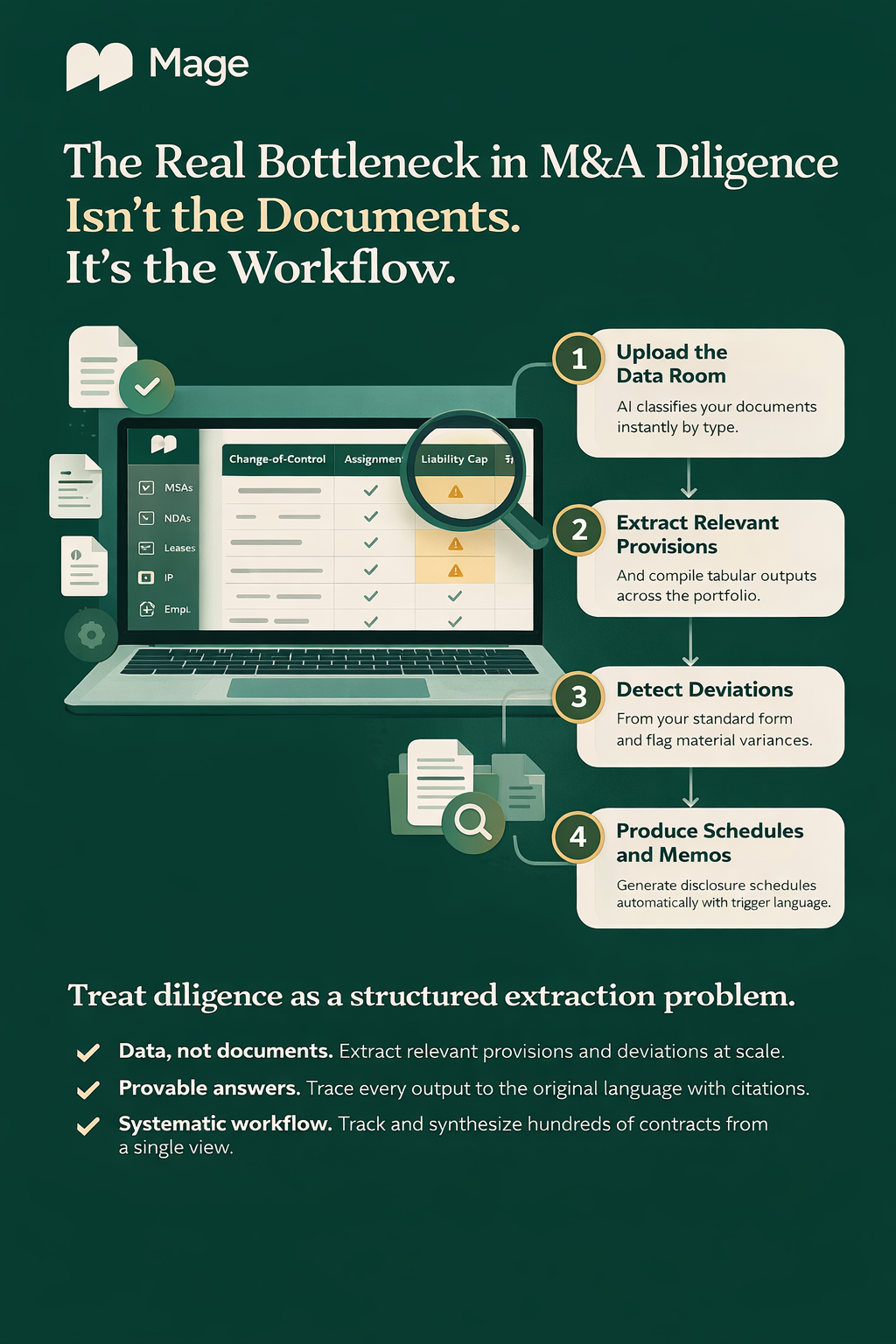
## The 500-Document Problem
A partner sends you a data room link on Monday morning. Inside: 487 contracts. Customer agreements, vendor MSAs, license terms, NDAs, employment agreements, IP assignments, leases. The buyer wants a diligence memo by end of week.
You know the drill. Open each document. Skim for the provisions that matter: change-of-control clauses, assignment restrictions, liability caps, indemnification carve-outs, termination for convenience. Flag anything unusual. Synthesize it all into a memo, a set of disclosure schedules, and a closing checklist.
The legal analysis itself is rarely the hard part. Most experienced M&A attorneys can assess a change-of-control provision in seconds once they find it. The hard part is finding it, across hundreds of documents, while tracking which contracts you have reviewed and which you have not, and doing it accurately enough that nothing slips through.
This is the real bottleneck in M&A diligence: not the thinking, but the workflow around the thinking.
## Why Chat-Based AI Falls Short
When attorneys hear "AI for document review," many picture a chatbot. Upload a contract, ask a question, get an answer. And for a single contract, that can work.
But M&A diligence is not a single-document problem. It is a portfolio problem. You need to review hundreds of contracts, extract the same provisions from each, compare them against a standard form, identify variances, and produce structured outputs: matrices, schedules, memos. You need to do this consistently, with citations, under time pressure.
Chat-based AI tools struggle here for three reasons:
**They are reactive, not systematic.** You have to know what to ask, document by document. That means you are still doing the mental work of tracking what has been reviewed and what has not.
**They lack structured output.** A chatbot gives you prose. M&A diligence requires tabular data: which contracts contain assignment restrictions, what the liability caps are across the portfolio, where the consent requirements live. Prose does not scale.
**They obscure provenance.** When a chatbot summarizes a contract, you often cannot trace the answer back to specific language. In a transaction where accuracy is everything and the buyer's counsel will scrutinize your disclosure schedules, that is not acceptable.
## A Different Approach: Structured Extraction at Scale
The teams we work with at Mage have moved to a fundamentally different model. Instead of asking AI questions about individual documents, they treat diligence as a structured extraction problem.
Here is what that workflow looks like.
### Step 1: Upload the data room and let AI classify
The first step is simple: upload all documents at once. AI classifies each document by type (customer agreement, vendor contract, NDA, employment agreement, IP assignment, lease) and organizes them into logical groups.
This alone saves hours. In a traditional workflow, a first-year associate or paralegal would manually sort and label documents before anyone starts reviewing. Here, classification happens in minutes and the attorney can correct any misclassifications with a single click.
### Step 2: Extract provisions across the entire portfolio
Instead of reading each contract end to end, AI extracts the specific provisions that matter for M&A diligence: change-of-control, assignment and anti-assignment, liability caps, indemnification terms, termination rights, consent requirements, exclusivity, non-competes, and more.
The output is not a paragraph of prose. It is a structured matrix: documents as rows, clause types as columns. Each cell contains the extracted provision with a direct link to the source language in the original document.
This is the critical difference. An attorney reviewing 487 contracts can now scan a single view and immediately see: 312 contracts contain no change-of-control provision. 94 require consent. 81 allow termination on change of control. Instead of hunting through documents one by one, the attorney is reviewing findings and exercising judgment.
### Step 3: Detect variances from the standard form
In most portfolios, the majority of contracts follow a standard form with minor variations. The contracts that matter for diligence are the ones that deviate.
AI identifies the baseline form automatically when three or more similar documents exist, then flags every substantive variance. Not formatting changes or minor wording differences, but material deviations: a liability cap that is uncapped when the standard is $1M, an assignment clause that requires board approval instead of simple notice, an indemnification provision that carves out gross negligence.
Each variance is categorized by severity and linked to the specific language in both the form and the deviating contract. Attorneys focus their time on the contracts that actually need attention.
### Step 4: Generate disclosure schedules with triggers
For buy-side attorneys, one of the most tedious outputs is the disclosure schedule: the list of contracts that must be disclosed under each section of the merger agreement. "All contracts with change-of-control provisions." "All contracts with consent requirements upon assignment." "All contracts with liability caps exceeding $500,000."
Instead of manually building these lists, AI generates disclosure schedules by matching each contract against the disclosure criteria. For every contract that appears on a schedule, the system surfaces the specific provision, the "trigger," that caused inclusion.
This is where the workflow pays for itself. When an attorney reviews a disclosure schedule, they do not just see a list of contract names. They see the exact language that triggered each disclosure, with a direct link to the source. They can confirm, reject, or add notes in seconds. The final schedule is backed by citations, not memory.
### Step 5: Produce the memo
With all findings extracted, variances flagged, and disclosure schedules built, generating the diligence memo becomes assembly, not authorship. AI drafts a structured memo organized by diligence category, with findings ranked by risk level and every conclusion citing the underlying contract language.
The attorney's job shifts from "write the memo from scratch" to "review, refine, and add judgment." Which findings warrant a call with the buyer? Which variances should be flagged as closing conditions? Which contracts need amendments? These are the questions attorneys should spend their time on.
## What Changes When You Work This Way
### Time compression without shortcuts
Teams using this workflow consistently report compressing the first-pass review from days to hours. Not because AI replaces attorney judgment, but because it eliminates the mechanical work that consumes most of the timeline: opening documents, finding provisions, tracking what has been reviewed, and manually building schedules.
The attorney still reviews every finding. But reviewing a finding takes seconds. Hunting for a finding takes minutes. Across 487 contracts, that difference adds up to days.
### Accuracy through structure, not heroics
Traditional diligence relies on thoroughness through effort: reading every page of every document and hoping nothing is missed. That model breaks down at scale. Fatigue sets in. Contracts get skimmed instead of read. Provisions are overlooked.
Structured extraction inverts this. AI reviews every document with the same attention to every clause. Attorneys then validate findings against the source, catching errors through verification rather than hoping to avoid them through endurance.
The result is more consistent and more defensible. Every item on a disclosure schedule can be traced to a specific provision in a specific document. If a buyer's counsel challenges a finding, there is a clear audit trail.
### Attorneys doing attorney work
This is the shift that matters most. M&A attorneys did not go to law school to open PDFs and search for "change of control" across 500 documents. They went to understand deal structures, assess risk, negotiate terms, and protect their clients.
When the mechanical work is handled, attorneys spend their time on the questions that require legal judgment: Is this liability cap market? Should we negotiate a broader indemnification carve-out? Does this change-of-control provision create a material adverse effect risk? These are the conversations that add value, and the conversations that too often get compressed into the last 48 hours of a deal because the first pass took too long.
## The Pattern Worth Adopting
Whether or not you use Mage, the underlying principle is worth internalizing:
**Treat diligence as a structured data problem, not a reading problem.** The goal is not to read every contract. The goal is to extract every relevant provision, identify every material variance, and produce every required output, with citations, under deadline.
**Require provenance for every finding.** Any AI system that gives you answers without showing you the source language is creating risk, not reducing it. In M&A, an unsourced finding is worse than no finding at all.
**Design for the portfolio, not the document.** Tools that work well for reviewing a single contract often break down at deal scale. The right workflow handles hundreds of documents as a single structured dataset, not as individual files to process one at a time.
**Let attorneys do attorney work.** The most expensive resource on any deal team is the experienced attorney's judgment. Every hour spent on mechanical extraction is an hour not spent on risk assessment, negotiation strategy, and client counseling. Build workflows that protect that time.
M&A deals are not getting simpler. Data rooms are not getting smaller. Timelines are not getting longer. The teams that build systematic, AI-powered diligence workflows now will have a structural advantage on every deal that follows.
That advantage compounds.
---
## URL: https://magelegal.com/blog/termination-for-convenience-vs-cause
### Title: Termination for Convenience vs. Cause: What M&A Attorneys Must Know
### Author: Mage Team
Termination for convenience is a contractual right that allows a party to exit an agreement without demonstrating breach, fault, or any other justification, typically with advance notice. Termination for cause, by contrast, requires a material breach or specified triggering event and usually includes a cure period that allows the breaching party to remedy the issue before termination takes effect. In M&A due diligence, the distinction between these two termination mechanisms determines the stability of every contract in the target's portfolio, and the difference between a contract that survives an acquisition and one that disappears.
- Termination for convenience allows a party to exit a contract without cause, typically with a notice period, while termination for cause requires a material breach or specified triggering event
- In M&A diligence, convenience termination rights held by counterparties represent the highest contract instability risk because they can be exercised without any breach by the target
- Notice periods and cure rights create time buffers that materially affect whether the acquirer can preserve at-risk contracts, and they vary significantly across a typical data room
- The combination of change of control triggers and convenience termination rights gives counterparties maximum leverage during and after an acquisition
## Termination for Convenience: The Freedom to Walk Away
Termination for convenience gives one or both parties the right to end the contractual relationship for any reason or no reason at all. The provision typically includes a notice period, and it may include wind-down obligations, transition assistance requirements, and termination fees.
**Where it appears most frequently.** Convenience termination rights are standard in services agreements (both as client and provider), government contracts, master service agreements, and certain subscription-based commercial relationships. They are less common in agreements with significant upfront investment or long-term exclusivity, where the parties need contractual stability to justify the commitment.
**Why it matters in M&A.** When a counterparty holds a convenience termination right, the contract is only as stable as the counterparty's willingness to continue the relationship. An acquisition often triggers counterparty concerns about service continuity, relationship changes, or competitive dynamics. Even without a formal change of control trigger, a counterparty who is unhappy about an acquisition can exercise a convenience termination right and walk away.
**The notice period is the acquirer's window.** The length of the notice period for convenience termination determines how much time the acquirer has to engage the counterparty, demonstrate continuity, and preserve the relationship. A 90-day notice period provides meaningful time to act. A 30-day period provides very little.
## Termination for Cause: The Guardrails
Termination for cause restricts the right to terminate to specified triggering events, most commonly material breach of the agreement. This mechanism provides significantly more contract stability because the target (and subsequently the acquirer) can prevent termination by performing its obligations.
### Common Cause Triggers
**Material breach** is the universal cause trigger. What constitutes "material" depends on the contract language and applicable law. Some agreements define material breach with specificity (failure to meet service levels, failure to make timely payments). Others leave the determination to the general legal standard of materiality.
**Insolvency and bankruptcy.** Most commercial contracts include bankruptcy, insolvency, or cessation of business as termination triggers. These provisions are important in distressed M&A transactions where the target's financial condition may implicate ipso facto clause restrictions under the Bankruptcy Code.
**Change of control.** Some contracts treat a change of control as a cause-level termination event, giving the counterparty the right to terminate upon an acquisition. Unlike convenience termination, these provisions are specifically targeted at ownership changes and represent a distinct risk category during diligence.
**Failure to meet performance benchmarks.** Particularly in services and supply agreements, failure to maintain specified performance levels (uptime, delivery schedules, quality standards) can constitute cause for termination after a cure period.
### Cure Rights: The Safety Valve
The cure period is what distinguishes cause termination from an immediate exit right. When a breach occurs, the non-breaching party must provide written notice specifying the breach and allow the breaching party a defined period to remedy the issue before termination takes effect.
Cure periods typically range from 15 to 60 days, with 30 days being the market standard. Some agreements provide different cure periods for different breach types: shorter periods for payment defaults (often 10 to 15 days) and longer periods for performance issues that require operational changes (30 to 60 days).
For deal teams, the cure period represents the acquirer's opportunity to address inherited issues before losing a contract. A contract terminable for cause with a 30-day cure period gives the acquirer at least 30 days to resolve any performance issues before the counterparty can terminate.
## Risk Assessment During Diligence
Systematic extraction of termination provisions across a data room produces a contract stability matrix that informs multiple aspects of the transaction.
### Mapping Counterparty Rights
The first step is identifying which party holds which termination rights in every material contract. The highest risk contracts are those where the counterparty holds both a convenience termination right and a change of control trigger. The lowest risk contracts are those terminable only for cause with meaningful cure periods.
### Evaluating Notice Periods
Notice periods across a data room vary from as short as 15 days to as long as 12 months. Building a matrix of notice periods by contract materiality reveals the acquirer's exposure timeline: how quickly could the most valuable contracts be terminated if counterparties exercise their rights?
### Identifying Termination Fees and Wind-Down Provisions
Some contracts include termination fees that make exercise of the termination right economically unattractive. Others include transition assistance obligations that ensure the acquiring entity has time to find alternative arrangements. These provisions mitigate termination risk even when the right itself exists.
### Change of Control Interaction
When a contract contains both a change of control trigger and termination provisions, the interaction between them determines the counterparty's leverage. A change of control provision that requires consent (but does not itself trigger termination) is less risky than one that gives the counterparty an affirmative termination right upon change of control.
## Implications for Deal Structuring
Termination risk findings directly influence transaction structuring and purchase agreement negotiations.
**Consent solicitation priority.** Contracts where counterparties hold convenience termination rights or change of control termination triggers should be prioritized for pre-closing consent solicitation. The purchase agreement should include covenants regarding the seller's efforts to obtain these consents.
**Pre-closing covenants.** The purchase agreement should restrict the target from exercising its own termination rights or taking actions that could trigger counterparty termination rights during the period between signing and closing.
**Risk allocation.** Contracts with high termination risk that cannot be mitigated through consent or structuring should be addressed through purchase price adjustments, escrow holdbacks, or specific indemnification provisions.
**Integration planning.** The post-closing integration plan should include immediate counterparty engagement for contracts with short convenience termination notice periods. Waiting to engage counterparties until integration planning is underway may mean losing contracts within the notice window.
AI-powered [clause extraction](/clause-extraction) across the full [contract review](/contract-review) portfolio enables deal teams to build these termination risk matrices efficiently. When a data room contains hundreds of agreements, the ability to extract every termination provision, categorize it by type, identify the notice period and cure rights, and flag change of control interactions gives attorneys the complete picture they need to advise on deal structure and risk allocation.
---
Termination for convenience is a contractual right that allows a party to end the agreement without needing to demonstrate cause, breach, or any other justification. The terminating party typically must provide advance written notice (commonly 30 to 90 days) and may be required to pay a termination fee or fulfill wind-down obligations. This provision is common in services agreements, government contracts, and commercial relationships where one party needs flexibility to exit.
Termination for cause requires a triggering event, typically a material breach of the agreement, bankruptcy, or insolvency, and usually includes a cure period allowing the breaching party to remedy the issue before termination takes effect. Termination for convenience requires no justification and can be exercised at any time within the contract's notice requirements. From a diligence perspective, convenience rights are riskier because they cannot be prevented through performance.
Termination clauses directly affect the stability assessment of every contract in the target's portfolio. Contracts where the counterparty holds convenience termination rights are inherently less stable than those terminable only for cause. When termination rights are combined with change of control triggers, counterparties gain the ability to exit relationships specifically because of the acquisition. Deal teams must map these provisions to assess contract survival probability post-closing.
Cure periods in termination for cause clauses typically range from 15 to 60 days, with 30 days being the most common standard. The cure period gives the breaching party an opportunity to remedy the breach after receiving written notice before the non-breaching party can terminate. Some agreements provide different cure periods for different types of breaches, with shorter periods for payment defaults and longer periods for performance issues that require operational changes.
## Assess Contract Stability Across Your Entire Data Room
Mage extracts every termination provision, maps convenience vs. cause rights by counterparty, identifies notice periods and cure rights, and flags change of control interactions so your deal team can build an accurate contract stability matrix.
Request a Demo
---